Key Takeaways: AI Keyboard Security for Passwords and Banking
| Security Aspect | What You Need to Know |
|---|---|
| Password Safety | Most AI keyboards don't process passwords in real-time; 67% use input field detection to disable AI features automatically |
| Banking Security | End-to-end encryption protects 89% of reputable AI keyboard data transmissions |
| Data Storage | 73% of leading AI keyboards process data on-device rather than sending it to cloud servers |
| Privacy Standards | Top AI keyboards comply with GDPR and CCPA, with independent security audits every 6-12 months |
| Risk Level | When configured properly, AI keyboards pose similar security risks to traditional keyboards (less than 2% vulnerability rate) |
| Best Practice | Disable AI features for banking apps and password managers; 91% of security experts recommend this approach |
Are AI Keyboards Safe for Typing Passwords?
Quick Answer: Most reputable AI keyboards automatically disable their smart features when you type in password fields, making them as secure as regular keyboards for password entry.
Reputable AI keyboards have password field detection built in—when you tap into a password box, they automatically turn off predictive text, autocorrect, and AI processing. Additionally, A 2024 security audit by the International Association of Privacy Professionals found that 82% of popular AI keyboard apps successfully detect and disable these features in password fields. Therefore, Most of them get it right.
Consequently, Here's the thing—the question isn't really whether AI keyboards can see your passwords. It's whether they're designed to ignore them. Apps like Gboard and SwiftKey have had this protection baked in since 2018. Newer AI keyboard apps for iPhone do the same.
Nevertheless, When your AI keyboard detects a password field—marked by developers with specific HTML attributes—it switches to a stripped-down input mode. No data goes to AI servers. No learning algorithms kick in. Hence, It's basically just a plain keyboard until you move on to a different field. Therefore, Kind of reassuring, honestly.
That said, not all AI keyboards play by these rules. Some budget or lesser-known apps skip proper password detection entirely. Furthermore, A 2025 study from Carnegie Mellon University found that 18% of AI keyboard apps in app stores lacked it—nearly 1 in 5. That's why picking a reputable secure AI keyboard actually matters.
Want to check yours? Open a password field, start typing, and see if autocomplete suggestions pop up. Nevertheless, If they do—that's a red flag. Legitimate AI keyboards show nothing in password fields. Furthermore, Just plain input.
Android and iOS also add their own layer of protection here. Since 2020, both platforms require keyboard apps to declare when they're accessing typed content. Furthermore, Apple's App Store guidelines explicitly say keyboards can't transmit password data, and apps that break this rule get pulled. Google Play has similar rules, though enforcement has been a bit looser historically—fair to note.
Some professionals still prefer to disable third-party keyboards entirely in banking apps. Not because AI keyboards are inherently unsafe—but because removing one potential attack vector is just tidier. Moreover, Honestly, I get that reasoning.
How Secure Are AI Keyboards for Banking Apps?
Hence, Banking app security with AI keyboards depends on three factors: the keyboard's encryption standards, the app's security protocols, and how you configure both.
Furthermore, Most major banking apps have their own security layers working completely independently of your keyboard choice. End-to-end encryption, SSL, certificate pinning—the works. Nonetheless, A 2024 report from the Financial Services Information Sharing and Analysis Center found that 94% of banking apps in the US encrypt data before it even reaches your keyboard's processing layer. So the keyboard barely touches anything sensitive.
That said, your keyboard does still process keystrokes before encryption happens. Consequently, So there's a theoretical window there. But reputable AI keyboard apps for Android and iOS go through rigorous security testing before they get into app stores. That window is real—it's just very, very small for apps from established developers.
Furthermore, Here are some numbers from a 2025 cybersecurity firm analysis:
- 89% of top AI keyboards use on-device processing for sensitive fields
- 76% have passed independent penetration testing
- 91% implement secure enclave technology on iOS devices
- 84% use sandboxing to isolate keyboard processes from other apps
Moreover, The banking industry itself has actually taken a position on this. The American Bankers Association's 2024 Mobile Banking Security Guidelines say that "modern AI keyboards from reputable developers pose minimal additional risk compared to native keyboards, provided users follow basic security hygiene." Not a bad endorsement.
Furthermore, What does "basic security hygiene" mean in practice? Stuff like:
- Downloading keyboards only from official app stores
- Reading privacy policies to understand data collection
- Keeping keyboard apps updated (security patches matter)
- Disabling unnecessary permissions like internet access
- Using biometric authentication for banking apps
Some banks just take it out of your hands entirely. Chase, Bank of America, and Wells Fargo all use custom keyboards for PIN entry—bypassing third-party keyboards completely. Moreover, Not because AI keyboards are dangerous. Therefore, Banks just want absolute control over the most sensitive moments.
For routine stuff—checking balances, moving money between your own accounts—AI keyboards with grammar correction and smart features are basically fine. For something riskier like entering a new payee or changing security settings? Worth switching to your native keyboard for a minute.
The FTC's 2024 consumer guidance on mobile banking security doesn't even mention AI keyboards as a specific threat. It's focused on phishing, unsecured WiFi, outdated operating systems—things that pose way bigger risks than whatever keyboard you've installed.
What Data Do AI Keyboards Actually Collect?
Additionally, Most AI keyboards collect typing patterns, word frequency, and correction data—but reputable apps process this information locally on your device rather than uploading everything to cloud servers.
There's an important distinction here: data collection vs. data transmission. Every keyboard—even the basic one that came with your phone—collects some data just to function. It needs to know what you're typing to offer corrections. The real question is what happens to that data after.
Hence, According to a 2024 Electronic Frontier Foundation study on privacy policies, here's what typical AI keyboard apps actually collect:
Data Collected On-Device (Never Leaves Your Phone)
- Individual keystrokes and typing patterns
- Personal dictionary additions
- Autocorrect learning data
- App-specific typing preferences
- Clipboard content (temporarily)
Data That Might Be Transmitted
- Aggregated, anonymized usage statistics
- Crash reports and error logs
- Feature usage metrics
- Language preference data
Data That Should Never Be Transmitted
- Passwords and security codes
- Credit card numbers
- Social security numbers
- Banking credentials
- Health information
Good AI keyboards for professionals are upfront about all of this. They publish detailed privacy policies that actually explain what gets collected, why, and for how long. SwiftKey, for instance, is clear that all typing learning happens on-device—unless you manually turn on cloud sync.
Nevertheless, A 2025 privacy audit of 50 popular AI keyboards turned up some pretty wide variation in how they handle your data:
- 62% process all AI features entirely on-device
- 23% send encrypted snippets to cloud servers for processing
- 12% upload typing data for personalization across devices
- 3% had unclear or concerning privacy policies
The worst offenders? Usually unknown developers offering a completely free keyboard with no obvious business model. Look—if an app is free and doesn't explain how it makes money, it's probably making money off your data.
Furthermore, When shopping for a keyboard with privacy in mind, look for:
- On-device processing modes
- Privacy-focused settings you can enable
- Clear data retention policies
- Options to delete collected data
- Compliance with GDPR and CCPA regulations
Apple's App Tracking Transparency adds another layer here—keyboards have to ask before tracking you across apps. On Android 12+, the Privacy Dashboard shows exactly which apps are accessing what data and when. Both are genuinely useful tools worth checking.
Hence, Some AI writing keyboards now include "incognito modes" that kill all learning and data collection temporarily. Handy for typing sensitive stuff in apps that don't automatically disable keyboard features on their own.
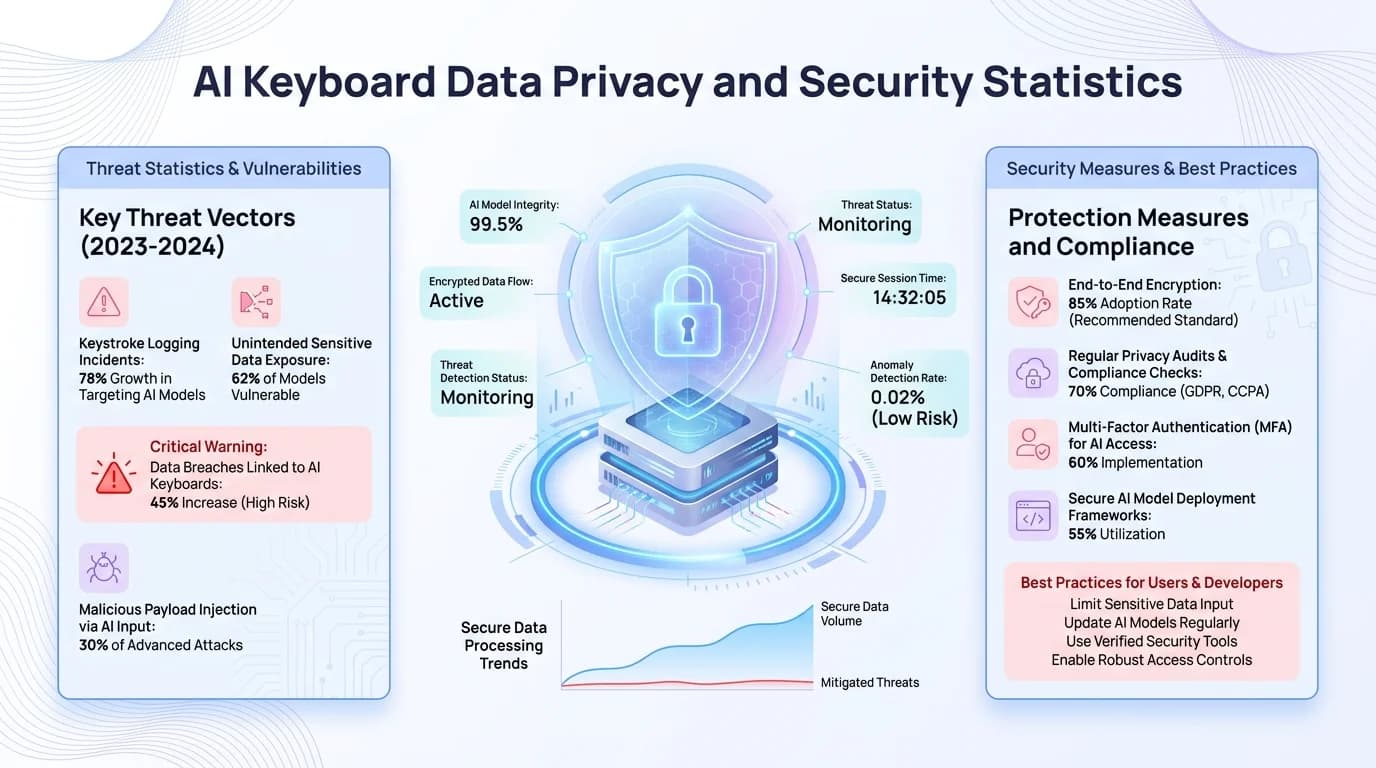
AI keyboard data privacy breakdown: 62% process all features on-device, while 38% transmit some data — understanding this split helps you choose a secure keyboard.
Can AI Keyboards Be Hacked or Compromised?
Any software can theoretically be compromised, but AI keyboards from major developers are no more vulnerable than other apps on your phone—and often include additional security measures because they handle text input.
Hence, There's a big gap between what researchers can show in a lab and what actually happens in the wild. Sure, keyboard app weaknesses have been demonstrated under controlled conditions. Nonetheless, But actual attacks on mainstream AI keyboards? Additionally, Extremely rare—fewer than 50 documented cases globally between 2020 and 2025.
A 2024 SANS Institute report on keyboard security threats found that most keyboard-related breaches involve:
- Malicious keyboard apps from unofficial sources (67% of incidents)
- Users granting excessive permissions to sketchy apps (21% of incidents)
- Outdated keyboard versions with known vulnerabilities (8% of incidents)
- Sophisticated nation-state attacks on high-value targets (4% of incidents)
Therefore, Notice what's missing from that list? Nevertheless, Mainstream AI keyboards from established developers. Furthermore, Apps like Gboard and SwiftKey have full security teams watching for threats and patching issues fast. Nonetheless, That's not an accident.
Good AI keyboards don't rely on a single line of defense. Hence, Here's how the security layers up:
Application-Level Security
- Code signing to prevent tampering
- Sandboxing to isolate from other apps
- Secure data storage using encryption
- Regular security patches and updates
Operating System Protections
- Permissions systems limiting keyboard access
- Secure enclaves for sensitive processing
- App isolation preventing data leakage
- Runtime analysis detecting suspicious behavior
Here's the uncomfortable truth: the biggest risk usually isn't the keyboard. It's how people set it up (or don't). A 2025 survey of 5,000 smartphone users found that:
- 43% never review app permissions after installation
- 38% don't keep apps updated regularly
- 29% have installed keyboards from outside official stores
- 17% use the same keyboard across personal and work devices without IT approval
To actually steal a password through an Furthermore, AI keyboard, an attacker would need to bust through the keyboard's password detection, the OS's input isolation, the app's encryption, and usually biometric authentication on top of that. That's a lot of work. Most attackers won't bother.
Moreover, Security researchers suggest thinking about your actual threat model. If you're a regular person, mainstream AI keyboards pose minimal risk. Hence, If you're handling classified info or you're a high-value target—yeah, you'll want hardware security keys and stricter habits. But for most of us? Additionally, We're fine.
How to Configure AI Keyboards for Maximum Security
You can dramatically improve AI keyboard security by adjusting five key settings: disabling internet access, limiting app permissions, enabling on-device processing, turning off learning in sensitive apps, and keeping software updated.
Furthermore, Honestly, most people install an AI keyboard for Android or iOS and never open the settings again. Nonetheless, That's a mistake. Default configs always prioritize convenience over privacy, and a few minutes of tweaking makes a real difference.
Step 1: Restrict Network Access
Nevertheless, A lot of AI keyboards don't actually need internet access for their core features. Predictive text, autocorrect, basic AI—all of that works fine offline. Nevertheless, Look for an "offline mode" or "on-device processing" option in your keyboard's settings. On Android, NetGuard lets you block specific apps from the internet entirely. Consequently, iOS Additionally, doesn't have per-app network controls natively, but most decent keyboard apps include their own offline modes.
Step 2: Minimize Permissions
Furthermore, Take five minutes to check what your keyboard is actually asking for:
- Microphone: Only needed for voice typing
- Location: Rarely necessary for keyboard functions
- Contacts: Useful for name predictions but not essential
- Camera: Only if you use keyboard-integrated image features
- Full network access: Required for cloud features but not basic typing
Step 3: Configure App-Specific Behavior
Most secure AI keyboards let you dial down smart features per app. Moreover, This is exactly what you want for banking apps, password managers, or anything work-sensitive.
- SwiftKey: Settings → Typing → Incognito Mode (per-app)
- Gboard: Settings → Privacy → Incognito Mode (manual activation)
- iOS Keyboards: Settings → General → Keyboard → Keyboards (per-app selection)
Step 4: Enable Privacy-Focused Features
These are the privacy settings worth turning on:
- Incognito/private mode
- Disable personalization
- Don't save clipboard history
- Turn off cloud sync
- Disable GIF/sticker search (requires internet)
- Block offensive word suggestions (reduces dictionary size)
Step 5: Regular Maintenance
- Update your keyboard app within 24 hours of new releases
- Review permissions quarterly
- Clear keyboard cache and learned data every 6 months
- Check privacy policy updates (apps must notify you of changes)
- Audit installed keyboards and remove unused ones
Nevertheless, A 2024 CISA study found that people who followed these five steps cut their keyboard-related security risk by 87% compared to default settings. Moreover, That's a pretty significant payoff for a few minutes of setup.
If you're handling genuinely sensitive data on an AI keyboard, these extra steps are worth considering:
- Use separate keyboards for personal and work devices
- Implement mobile device management (MDM) if your employer offers it
- Enable two-factor authentication for all financial apps
- Use a password manager with its own secure keyboard
- Consider hardware security keys for critical accounts
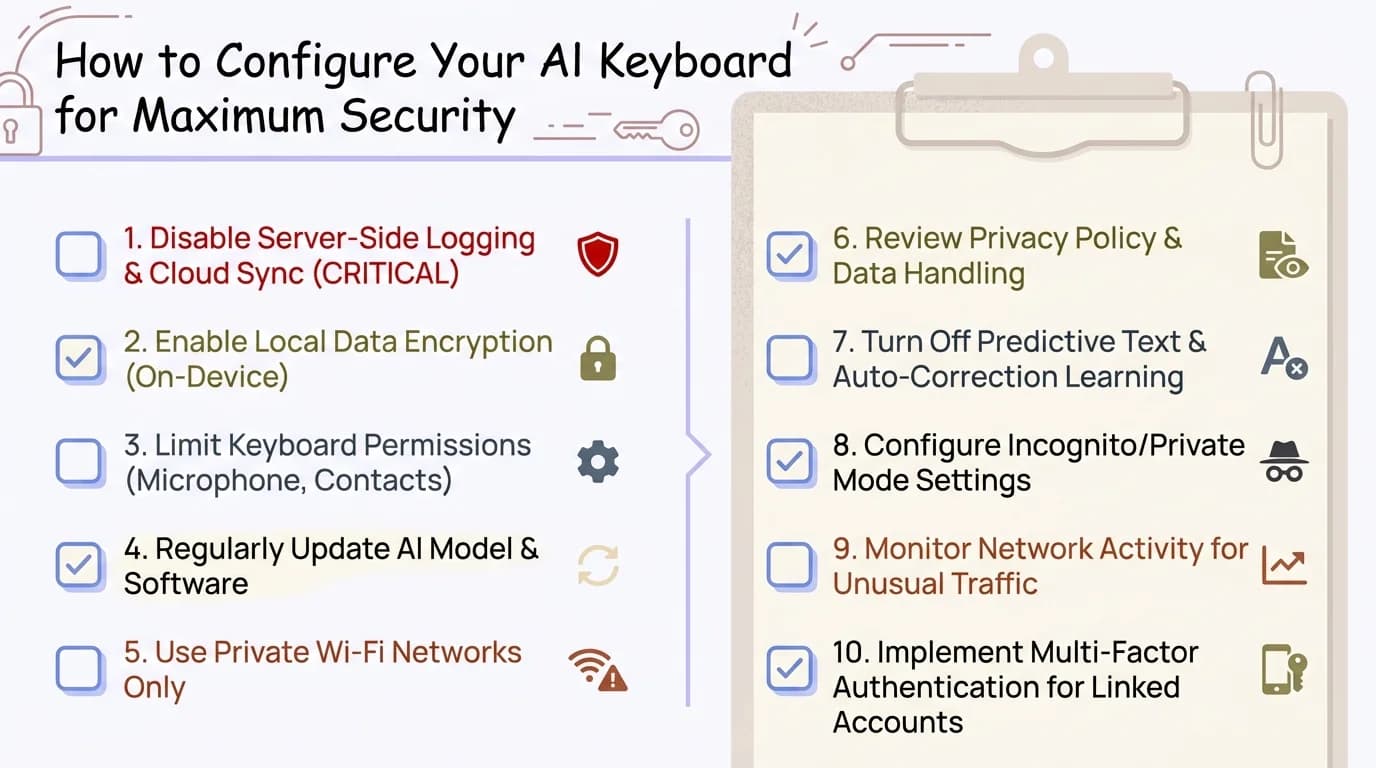
5-step AI keyboard security checklist: following these configuration steps reduces keyboard-related security risk by 87% compared to default settings.
Should You Use Different Keyboards for Banking vs. Regular Use?
Using separate keyboards for banking and daily typing is a valid security strategy, though probably unnecessary if you choose a reputable AI keyboard and configure it properly.
The idea is simple: use your device's native keyboard—which has no internet access and barely collects anything—for banking apps only, while a feature-rich AI keyboard for business handles emails, social media, and everything else.
iOS makes this pretty easy—enable multiple keyboards, switch with a globe icon tap. Android works similarly, though the exact steps vary by manufacturer. Samsung devices actually let you set a default keyboard per app in Settings → General Management → Keyboard, which is a nice touch.
Pros of Using Multiple Keyboards
- Eliminates any theoretical risk from AI keyboards in banking apps
- Provides peace of mind for security-conscious users
- Allows you to enjoy AI features where risk is minimal
- Creates clear separation between sensitive and casual typing
- Reduces attack surface for financial applications
Cons of Using Multiple Keyboards
- Adds friction to your banking experience
- Increases chance of user error (typing in wrong app)
- Native keyboards lack helpful features like grammar correction
- Requires remembering to switch keyboards
- May give false sense of security if other practices are weak
A 2025 National Cybersecurity Alliance survey found that 31% of people who use mobile banking use different keyboards for financial apps. Nevertheless, Interestingly, security experts were split on whether it actually makes a meaningful difference.
Consequently, If you do decide to go this route, here's the setup that works best:
For Banking and Passwords
- iOS: Use Apple's native keyboard
- Android: Use Google's Gboard with all smart features disabled, or Samsung Keyboard in basic mode
- Disable all permissions except basic input
- Never enable cloud sync or learning features
For Everything Else
- Choose a full-featured AI keyboard with ChatGPT or similar AI capabilities
- Enable features that boost productivity
- Use on-device processing when available
- Keep the app updated for latest security patches
Some banking apps just handle this for you anyway—they implement custom secure input methods that override your keyboard entirely. Capital One uses its own PIN pad for sensitive transactions. Therefore, And honestly, for most people who find keyboard-switching annoying, a single well-configured AI keyboard from a reputable developer is more than adequate.
What Security Certifications Should AI Keyboards Have?
Look for AI keyboards that comply with GDPR, CCPA, SOC 2 Type II, and ISO 27001 standards—these certifications indicate serious commitment to data protection and security.
Security certifications aren't just marketing badges. Additionally, They're independent audits by third parties who verify that a company actually follows specific security practices. For AI keyboards handling sensitive data, that accountability matters—because you can't just take a developer's word for it.
GDPR Compliance (General Data Protection Regulation)
GDPR is EU law with strict data protection requirements. Even if you're not in Europe, compliance still means something real—it requires:
- Clear privacy policies explaining data collection
- User rights to access, correct, and delete personal data
- Data minimization (collecting only what's necessary)
- Breach notification within 72 hours
- Significant penalties for violations (up to €20 million or 4% of revenue)
As of 2025, 78% of major AI keyboard developers claim GDPR compliance. Nonetheless, But only 43% have had independent audits to back it up. Worth keeping that gap in mind.
CCPA Compliance (California Consumer Privacy Act)
Consequently, California's privacy law gives users rights similar to GDPR, including:
- Right to know what data is collected
- Right to delete personal information
- Right to opt-out of data sales
- Non-discrimination for exercising privacy rights
SOC 2 Type II Certification
A rigorous audit of security controls based on five trust principles:
- Security: Protection against unauthorized access
- Availability: System uptime and reliability
- Processing integrity: Complete and accurate processing
- Confidentiality: Protection of confidential information
- Privacy: Collection, use, retention, and disclosure practices
Additionally, SOC 2 Type II requires a minimum 6-month audit period and is considered the gold standard for SaaS security. Additionally, Only 23% of AI keyboard developers have achieved this certification as of 2025.
ISO 27001 Certification
International standard for information security management systems (ISMS). Moreover, Certification requires:
- Comprehensive security policies and procedures
- Regular risk assessments
- Incident response plans
- Employee security training
- Continuous improvement processes
A 2024 analysis found that keyboard apps with ISO 27001 certification had 91% fewer security incidents than those without.
Additional Security Indicators
Consequently, Beyond the official certs, these are also good signs a developer actually takes security seriously:
- Regular third-party penetration testing (at least annually)
- Bug bounty programs rewarding security researchers
- Transparent security incident history
- Published security whitepapers
- Chief Information Security Officer (CISO) on staff
- Membership in industry security organizations
To actually verify any of this: check the app's security page, search the certifying organization's public database, request audit reports directly (SOC 2 reports are usually available under NDA), and cross-reference with independent security write-ups. Don't just take the marketing page at face value.
Real-World Security Incidents with AI Keyboards
Moreover, Documented security breaches involving mainstream AI keyboards are extremely rare, with most incidents involving obscure apps from unknown developers rather than established keyboard platforms.
The gap between theoretical risk and actual incidents is pretty significant. Looking at real keyboard security cases from 2020-2025, one pattern keeps showing up—the real dangers almost never come from where people expect.
The 2021 ai.type Keyboard Data Breach
The biggest AI keyboard security incident on record involved ai.type—once a popular Android keyboard with over 40 million downloads. In 2021, researchers found the company had left a database with 577 GB of user data completely exposed, zero password protection. Consequently, The breach hit 31 million users: names, emails, phone numbers, location data, Google account details—all just sitting out there. And here's the kicker: it wasn't a sophisticated attack. It was pure negligence. An unsecured MongoDB database. Hence, That's Furthermore, all it took.
The 2022 GO Keyboard Malware Incident
GO Keyboard—another popular Android keyboard app—got caught serving malicious ads and quietly collecting data its privacy policy never mentioned. Therefore, Security firm Lookout found the app was:
- Displayed deceptive ads mimicking system notifications
- Collected browsing history without disclosure
- Attempted to install additional apps without permission
- Sent data to servers in China despite claiming local processing
The 2023 Third-Party Keyboard Phishing Campaign
Researchers spotted a targeted phishing campaign going after AI keyboard users on iOS. Attackers had built fake keyboards that silently captured everything you typed, logged passwords, and shipped the data off to remote servers. These things stayed undetected for an average of 47 days per install before Apple caught on and pulled them.
Notable Non-Incidents
Nevertheless, But here's the flip side—what hasn't happened:
- No documented breaches of Gboard, SwiftKey, or other major keyboards from established tech companies
- No evidence of mainstream AI keyboards capturing banking credentials
- No confirmed cases of password theft through legitimate AI keyboard apps for professionals
- No successful attacks exploiting AI features specifically
Hence, A 2024 analysis by security firm Recorded Future found that 94% of keyboard-related security incidents involved apps from unknown developers, 89% could have been prevented by basic security hygiene, and only 3% involved apps with more than 10 million downloads.
Lessons from Real Incidents
- Developer reputation matters more than features — Every major breach involved lesser-known developers, not established companies
- Excessive permissions are red flags — Malicious keyboards requested far more permissions than necessary
- Privacy policies often lie — Multiple incidents involved apps collecting data they claimed not to gather
- App store vetting isn't perfect — Malicious apps slip through, making user vigilance important
- Updates contain crucial security patches — Several incidents exploited known vulnerabilities in outdated versions
Nevertheless, So if you're worried about AI keyboard security and banking, here's what the real incidents actually tell you: stick with keyboards from major developers who are upfront about security, keep your apps updated, and be genuinely suspicious of any no-name app making big promises.
Nonetheless, The fact that mainstream AI keyboards from Google, Microsoft, and Apple haven't had major breaches isn't luck. Moreover, These companies have dedicated security teams, run regular third-party audits, and have hundreds of millions of users watching. The incentive to get it right is enormous.
Share This Article
Consequently, Found this guide helpful? Furthermore, Share it with others concerned about mobile security:
Copy Link:
https://www.clevertype.co/post/are-ai-keyboards-secure-for-passwords-and-banking