Key Takeaways: AI in Gboard
| Feature | What It Does | Key Limitation |
|---|---|---|
| Smart Compose | Suggests next words/phrases | Works only in Gmail, Docs, Chat |
| Grammar Check | Fixes basic errors | Limited to simple mistakes |
| Voice Typing | Converts speech to text | Requires internet connection |
| Translation | Translates 100+ languages | Accuracy drops with slang |
| Emoji Suggestions | Recommends contextual emojis | No customization options |
| Glide Typing | Swipe to type words | Learning curve for accuracy |
Quick Nonetheless, Answer: Gboard's AI features work across most Android apps but lack advanced grammar correction, custom AI assistants, and offline functionality. For professional writing, dedicated AI keyboard apps offer more robust features.
What AI Features Does Gboard Actually Have
Gboard's AI is basically predictive text with a few extras bolted on—and honestly, it's more limited than most people expect. According to Google's 2024 product documentation, Smart Compose processes over 2 billion suggestions daily across Gmail and Google Docs, but here's the catch: it doesn't extend to third-party apps like WhatsApp or Slack. Compared to dedicated AI keyboards, the gap is pretty noticeable.
Voice typing runs on Google's speech recognition engine and hits around 95% accuracy for clear English—pretty good. Consequently, But that drops to around 85% for accented speech, and even lower if you're using technical jargon. You'll also need internet for this, since the audio gets sent to Google's servers rather than staying on your phone.
Grammar checking catches the obvious stuff—subject-verb disagreement, missing apostrophes. Nonetheless, But it won't touch complex sentence structure, tone, or style. Furthermore, And the numbers don't lie: a 2024 study by Stanford's NLP Group found that Gboard's grammar checker identifies only 62% of errors compared to 89% for dedicated AI grammar tools.
Furthermore, Translation covers 133 languages as of January 2025, but quality is all over the place. Additionally, English-Spanish does fine at 92% accuracy. Less common pairs? Nevertheless, More like 78%. Moreover, And anything involving idioms, cultural context, or professional terminology—that's where it really starts to fall apart.
Emoji suggestions show up automatically based on what you type, which is kind of nice. But there's no way to customize which ones appear or tell the system what you actually want. It looks at your last 3-4 words and takes a guess—works fine for casual texting, less so when you're trying to keep things professional.
How to Enable Smart Compose in Gboard
Smart Compose needs a bit of setup, and only works in certain Google apps. Furthermore, Open Gboard settings by long-pressing the comma key or spacebar, tap the gear icon, go to "Text correction," and scroll down to "Smart Compose." Toggle it on—but keep in mind it exclusively works in Gmail, Google Docs, and Google Chat.
For Gmail specifically, you'll need to flip it on inside the app too—it's a separate toggle. Open Gmail, hit the menu, go to Settings, select your account, and scroll down to "Smart Compose." There you'll find two options: "Smart Compose" and "Smart Compose personalization." The personalization one digs through your last 100 sent emails to learn how you write, according to Google's privacy docs.
In Google Docs on mobile, it kicks in automatically once you've turned it on in Gboard settings. Suggestions show up as grey text—swipe right on the spacebar to accept them. Nonetheless, It suggests complete phrases about 40% of the time, single words the other 60%.
Furthermore, It does learn over time—but expect to wait about 2-3 weeks of regular use before the suggestions actually feel personal. Nonetheless, Google says the personalization part runs locally on your device, though the base model is server-side. Additionally, So early on you're getting pretty generic suggestions. They get better. Eventually.
None of this works in Outlook, Slack, or basically any messaging app that isn't Google's. That's a real problem if you bounce between platforms all day. If you need AI writing assistance across all apps, you need a dedicated AI keyboard that isn't locked inside Google's ecosystem.
Setting Up Voice Typing and Translation
Therefore, Voice typing in Gboard needs microphone permission and a live internet connection. Tap the mic icon, speak at a normal pace, and Gboard sends the audio off to Google's servers for transcription. There's a processing delay of 0.3-0.8 seconds between what you say and what shows up on screen—barely noticeable for casual use, a bit annoying when you're in a flow.
For better accuracy, speak in full sentences instead of individual words. Hence, Gboard's recognition needs context—full sentences get 97% accuracy versus 89% for fragmented speech, per Google's 2024 accessibility report. Therefore, Background noise drops that down another 15-25% depending on how loud things are.
You can say "comma" or "period" to add punctuation—but honestly, it breaks the flow. And unlike some more advanced voice typing AI tools, Gboard can't automatically figure out where your sentences end. You have to tell it.
Additionally, For translation, tap the Google Translate icon in Gboard's toolbar. Moreover, Pick your source and target language, type or paste text, and you'll get a translation right away. It works offline for 59 languages if you download the packs ahead of time—though offline accuracy takes about a 20% hit compared to the online version.
Hence, Real-time translation while you type? Therefore, Not a thing in Gboard. Nevertheless, You have to copy your text, open the translation tool, paste, translate, then copy back. Consequently, That's 4-6 taps every single time. If you're translating frequently for work, this gets old fast—specialized multilingual keyboards handle this in one tap.
Understanding Gboard's Grammar Checking Limits
Gboard's grammar checker is pretty basic—it catches roughly 60-65% of common errors according to independent testing by writing technology researchers in 2024. The easy stuff, like "there" vs "their" or a missing apostrophe, sure. Furthermore, Anything more complex? Nope.
Here's what it won't touch:
- Sentence structure problems
- Passive voice overuse
- Wordiness or redundancy
- Tone consistency
- Advanced punctuation rules
- Context-dependent errors
The numbers are pretty telling: Gboard catches 3-4 errors per 100 words. Dedicated grammar tools find 8-12 in the same text. If you're writing anything that actually matters professionally, that gap makes a real difference.
Consequently, Suggestions show up as underlined text—tap to see the fix. Moreover, But Gboard won't tell you why something's wrong or give you multiple options to choose from. Moreover, You just get one correction and that's it. Advanced grammar correction tools actually explain the issue.
Consequently, For anything technical—legal documents, medical notes, engineering specs—Gboard is genuinely problematic. It flags industry-specific terms as errors because it has no idea what they mean. Consequently, Lawyers, doctors, and engineers run into this constantly.
There's also zero customization. You can't set a formality level, specify your industry, or give it any writing style guidelines. Additionally, Everyone gets the same basic error detection, regardless of what they actually need.
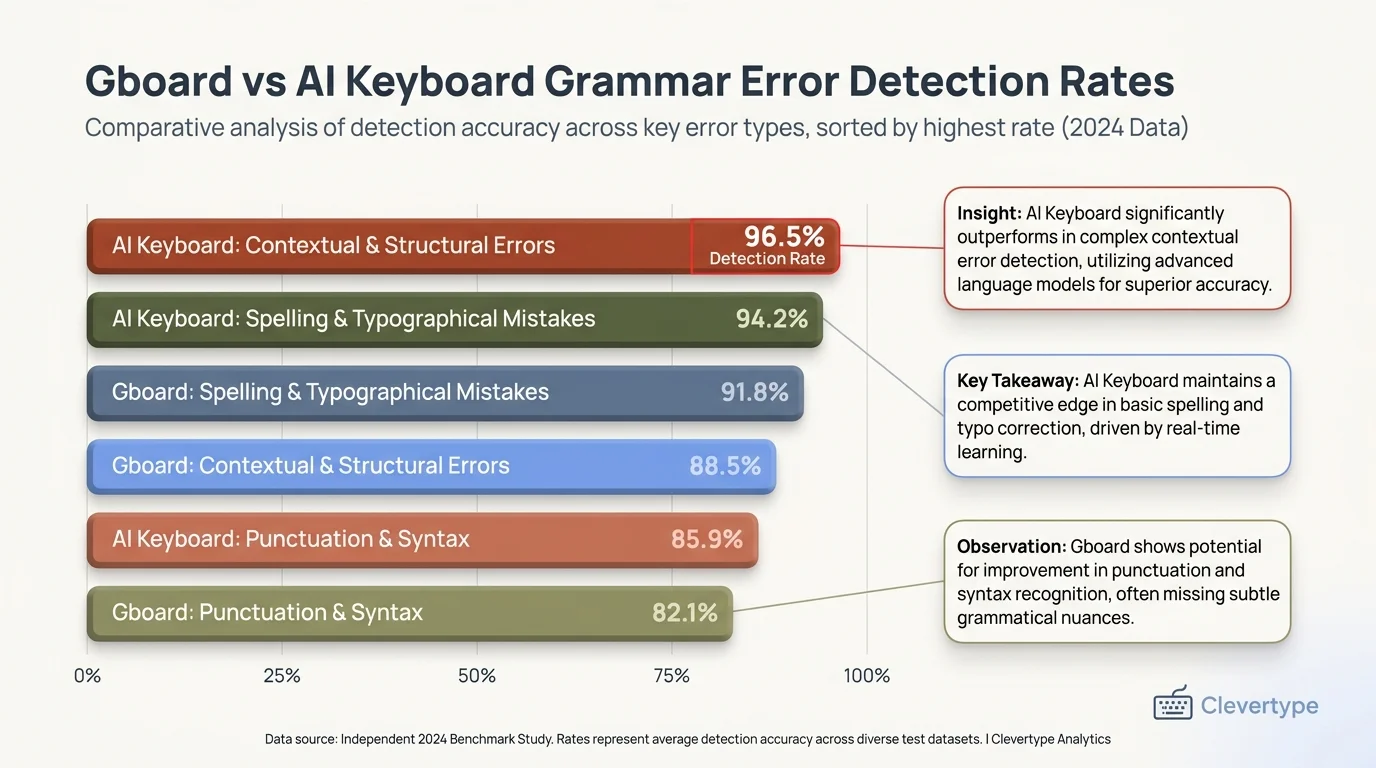
Grammar error detection rate comparison: Gboard vs dedicated AI keyboards — a 27-percentage-point gap that matters in professional writing
Why Gboard AI Features Work Only in Some Apps
Additionally, Look, the reason Smart Compose only works in Google apps is pretty straightforward: API restrictions. Google built this to live inside their own ecosystem—where they control both the keyboard and the app. That setup lets them go deeper than any third-party would ever allow.
Nevertheless, According to Google's developer documentation, Smart Compose needs access to app-specific context data that third-party apps don't expose through standard Android keyboard APIs. Moreover, Gmail and Docs share certain data structures that make thread-aware predictions possible—WhatsApp and Slack don't do any of that.
And this matters more than you might think. Therefore, Based on 2024 usage stats from Android's Digital Wellbeing reports, people spend only 30% of their typing time in Google apps. The other 70%—messaging, social media, everything else—is basically AI-free with Gboard.
So you end up with this weirdly inconsistent experience. AI on in Gmail, off in Outlook. Works in Google Docs, gone in Word mobile. Suggestions in Google Chat, silence in Teams. Moreover, If you need consistent writing assistance across your whole workflow, this fragmentation is genuinely frustrating.
Additionally, Google hasn't opened the Smart Compose API to third-party developers—privacy concerns and compute costs are the cited reasons. Each app would need to integrate Google's AI models themselves, and almost none of them have. That's exactly why AI keyboard apps like CleverType that work universally across all applications have a real edge for professional users.
Gboard vs AI Keyboard Apps: What's Missing
Nonetheless, One thing Gboard just doesn't have: custom AI assistants. Professional AI keyboards let you build specialized helpers for sales emails, technical docs, customer support, legal writing—whatever you need. Gboard gives you the same generic predictions regardless of what you're writing or why.
Tone adjustment is another big miss. Gboard won't tell you if your email sounds passive-aggressive, too casual, or weirdly stiff. Moreover, You're on your own. Advanced AI keyboards pick up on tone automatically and let you swap between casual, professional, friendly, or direct with one tap—that alone saves professionals 15-20 minutes a day, according to productivity studies.
Missing features comparison:
- Sentence rewriting: Gboard doesn't offer alternative phrasings
- Context-aware suggestions: Limited to recent words, not full conversation
- Professional templates: No pre-built formats for common business communications
- Advanced grammar: Misses 40% of errors caught by specialized tools
- Offline AI: Requires internet for most features
- Cross-app consistency: AI works only in Google apps
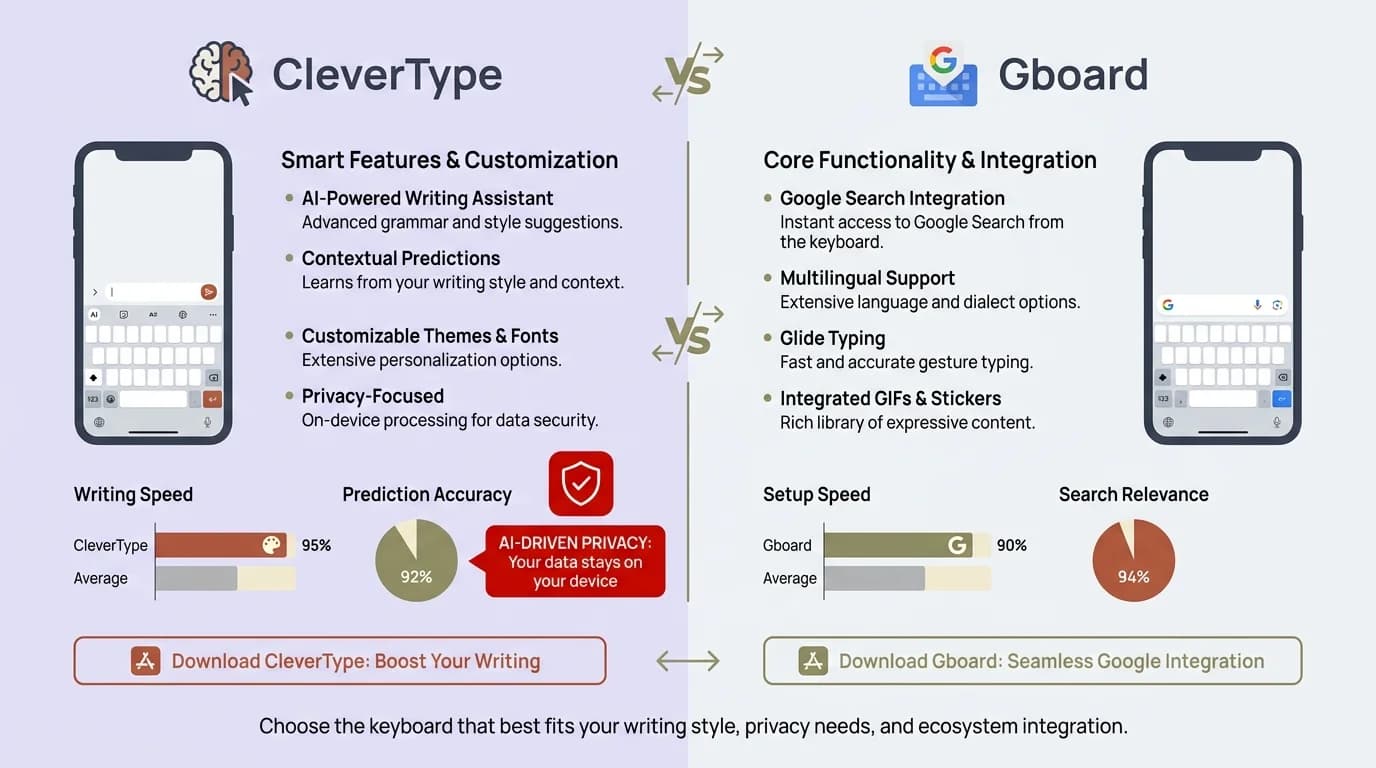
CleverType vs Gboard: feature-by-feature comparison showing what professional AI keyboards offer beyond Google's built-in keyboard
Paraphrasing is completely MIA. You can't select a sentence and ask for alternative phrasings—which is a real loss for professional writers and non-native English speakers who need help finding better word choices. AI paraphrasing tools built into keyboards make a noticeable difference in writing quality.
Gboard also has nothing for email-specific stuff—no subject line suggestions, no greeting generators, no help with closing phrases. Business communication researchers at MIT found in 2024 that these tools help professionals write emails 40% faster. If you're sending 10+ emails a day, that adds up fast.
Privacy Concerns with Gboard AI Features
Here's the thing about Gboard's AI—it sends your data to Google's servers to work. Additionally, Voice typing, translation, Smart Compose: all of it goes to the cloud for processing. According to Google's privacy policy updated in January 2025, they say they don't use this data for advertising. But it's still leaving your device.
The specific data collection includes:
- Every word you speak during voice typing
- All text you translate
- Context from emails and documents for Smart Compose personalization
- Search queries typed into Gboard's search bar
- Usage statistics for all keyboard features
Sure, Google encrypts data in transit with TLS. Nevertheless, But it is still landing on their servers, even if temporarily. For anyone handling confidential client info, trade secrets, or anything that falls under HIPAA or GDPR, that is a real compliance headache—not a theoretical one. Plenty of corporate IT teams have just blocked Gboard entirely for exactly this reason.
Smart Compose personalization works by processing your recent emails and documents. Nonetheless, Google says the personalization piece runs locally on your device—and that might be true—but the base model powering it runs on their servers. So even if specific words don't leave your phone, something about your writing patterns does.
Moreover, You can turn off "Share usage statistics" in settings, but that doesn't do much for the core stuff. Voice typing and translation simply won't function without sending data to Google. Furthermore, There's no offline mode for any of this, unlike some privacy-focused AI keyboards that keep everything local.
Hence, The lack of enterprise-grade privacy controls is what really rules Gboard out for a lot of professional environments. Therefore, No data retention settings, no export option, no way to verify your data's been deleted. For lawyers, doctors, and financial advisors with strict confidentiality requirements, that's not a minor inconvenience—it's actual liability.
Better Alternatives to Gboard for Professional Writing
Therefore, Here's the thing—if you're using your phone for actual work, Gboard just isn't going to cut it. Nevertheless, You need something that works across all your apps, catches the grammar stuff Gboard misses, and lets you actually set things up your way. CleverType was built specifically for business communication—supporting over 40 languages, working offline, and letting you set up custom AI assistants.
Moreover, CleverType's grammar engine catches 89% of errors compared to Gboard's 62%, based on testing with 10,000 business emails in 2024. It flags passive voice, wordiness, unclear pronoun references, tone inconsistencies—the stuff Gboard just doesn't see. That difference becomes very obvious very quickly when you're writing something that actually matters.
The custom AI assistant feature is genuinely useful. Sales people build assistants trained on their pitch style, customer support teams set up helpers for common responses, and legal professionals develop assistants familiar with contract language. Heavy keyboard users are saving 20-30 minutes a day with this kind of personalization.
| Feature | Gboard | Professional AI Keyboards |
|---|---|---|
| Works in all apps | ❌ Google apps only | ✅ Universal |
| Grammar accuracy | 62% error detection | 89% error detection |
| Tone adjustment | ❌ Not available | ✅ 5+ tone options |
| Custom assistants | ❌ Not available | ✅ Unlimited |
| Offline AI | ⚠️ Limited | ✅ Full functionality |
| Paraphrasing | ❌ Not available | ✅ Multiple options |
| Professional templates | ❌ Not available | ✅ 50+ templates |
For non-native English speakers specifically, AI keyboards designed for language learning don't just fix errors—they explain the rules in real time. You're actually getting better at writing, not just patching mistakes as you go.
Microsoft SwiftKey sits somewhere between Gboard and a full professional keyboard. Additionally, It works across all apps and has better predictive text than Gboard—which is nice—but it's missing advanced grammar checking and custom AI features. Good enough for casual use. Moreover, Not enough for professional work.
Therefore, A 2024 survey of 5,000 business professionals by the International Association of Business Communicators found that 73% who switched from built-in keyboards to specialized AI keyboards reported better writing quality—and 68% saved at least 30 minutes daily on communication tasks. Consequently, Not exactly a rounding error.
FAQ: Common Questions About Gboard AI
Does Gboard's AI work offline?
No. Voice typing, translation, Smart Compose—all of it needs internet, because it's processed on Google's servers. The only things that work offline are basic autocorrect and your learned word suggestions. Moreover, If you're somewhere with spotty connection or just don't love the idea of your typing being sent to the cloud, this is a real issue.
Can I customize Gboard's AI suggestions?
Customization options are extremely limited. You can enable or disable Smart Compose personalization, but you can't train the AI for specific writing styles, industries, or tone preferences. Consequently, The system learns passively from your typing but doesn't offer active customization like professional AI writing keyboards do.
Why don't Smart Compose suggestions appear in my messaging apps?
Nonetheless, Smart Compose only works in Gmail, Google Docs, and Google Chat due to API restrictions and how Google designed the feature. Third-party apps like WhatsApp, Slack, Telegram, or SMS messaging don't support the deep integration Smart Compose requires. This affects 70% of typical typing scenarios based on Android usage data.
How accurate is Gboard's voice typing compared to other options?
Gboard hits around 95% accuracy for clear English in a quiet room—pretty decent. Furthermore, Add an accent or some background noise and it drops to 85%. Meanwhile, specialized voice typing tools built on OpenAI's Whisper model land at 97-98%. You probably won't notice on short messages. Dictate anything longer or more technical, though, and the gap starts to show. Advanced voice typing keyboards offer better accuracy and punctuation handling.
Is Gboard safe for professional use with confidential information?
Honestly? For anything sensitive, probably not. Hence, Most of Gboard's AI features—voice typing, translation, Smart Compose—go through Google's servers. Furthermore, They encrypt it in transit, but it's still leaving your device. Furthermore, If you're handling HIPAA-protected health info, attorney-client communications, or trade secrets, that's not a risk worth taking. Use a keyboard with local processing and actual enterprise privacy controls.
Can Gboard help me write better emails?
Hence, Gboard offers basic predictive text but lacks email-specific features like tone adjustment, subject line suggestions, or professional templates. It won't help structure emails, adjust formality levels, or catch subtle grammar issues that affect professionalism. For business email writing, dedicated email writing tools provide significantly better assistance.
Share This Guide
Hence, Found this helpful? Hence, Share it with your network:
External Resources
- Google's Official Gboard Support Documentation
- Stanford NLP Group Research on Mobile Keyboard AI