How How to Text Like Professional Is Changing the Way We Type
By Zayan Farooq • Updated: Jan 26, 2026
Key Takeaways:
- AI-powered keyboards like CleverType are transforming professional communication
- Professional texting tools help eliminate grammar errors and typos instantly
- Tone adjustment features allow switching between formal and casual communication
- Mobile professional writing is becoming more efficient with predictive text
- AI writing assistants help non-native speakers communicate more confidently
- Custom writing assistants can be tailored to specific professional needs
- Privacy-focused texting tools keep sensitive business communications secure
Ever wondered how people went from typing like teenagers to sounding like CEOs in their texts? It's not magic—it's AI doing the heavy lifting. The evolution of professional texting tools has completely transformed how we communicate on our devices. Remember when we'd send messages full of abbreviations and emoji just to save time? By 2026, those casual shortcuts have become rare in professional settings, replaced by polished, AI-assisted communication that takes seconds, not minutes.
Professional texting today is way more than avoiding "u" instead of "you." It's become a sophisticated ecosystem of AI tools that help us communicate more effectively, more professionally, and with surprisingly little effort. The shift has been dramatic—what once required careful proofreading and multiple drafts now happens in real time, right as you type. But how exactly is this happening? What tools are driving this change? And more importantly, how are real people actually using them in 2026?
Let's explore how professional texting tools are reshaping our communication habits, and why they've become essential for anyone who wants to sound sharp without spending all day crafting the perfect message.
The Evolution of Mobile Text Communication
Remember when texting was just SMS, and we had to press the number 7 four times just to type the letter "s"? Gosh, those were the days. But look how far we've come! The journey from T9 predictive text to today's AI-powered keyboards is nothing short of revolutionary.
In the early 2000s, we were all about shortening everything. "C u l8r" was perfectly acceptable, even professional in some contexts. Why? Cuz typing was tedious and screens were tiny. We had to make do with what we had.
Then smartphones arrived, and suddenly we had full QWERTY keyboards at our fingertips. But even with better keyboards, we still made plenty of mistakes. Autocorrect became both our savior and the source of embarrassing mishaps. How many professional messages have been derailed by an autocorrect fail? Too many to count!
By 2026, we're living in the golden age of AI keyboard apps that don't just correct typos—they understand context, suggest appropriate responses, and even adjust tone based on who you're messaging. These tools have become so sophisticated that they can detect whether you're texting your manager versus your colleague and adjust their suggestions accordingly. The evolution hasn't just been about technology; it's fundamentally changed our expectations of what professional communication should look like, even on mobile devices.
What used to be acceptable only in casual contexts is now expected to maintain a level of professionalism previously reserved for formal letters and emails. As one user put it, "I used to save my proper writing for emails, but now I find myself being just as careful with my texts and messages because the tools make it so easy."
AI-Powered Keyboards: The Game Changers
So what's the big deal with these fancy new keyboards? Aren't they just glorified autocorrect? Not even close! AI keyboards have become sophisticated writing assistants that fit in your pocket.
The most obvious benefit? They fix your mistakes before anyone sees them. But it goes way deeper than that. These tools actually learn your writing style and adapt to it. They understand that how you text your boss is different from how you text your bestie.
Consider CleverType, which doesn't just correct grammar but offers tone adjustment features that help you sound more professional when needed. It's like having a tiny editor who whispers in your ear, "Maybe don't use 'wassup' in that message to the board of directors."
These keyboards also save massive amounts of time through predictive text that actually works. They don't just predict the next word; they can predict entire phrases based on context. Some users report cutting their typing time in half! Who wouldn't want that?
"I was skeptical at first," says marketing executive Jamie Chen. "But my AI keyboard has saved me from so many potential embarrassments in client chats. It catches things I would've missed when I'm typing quickly between meetings."
The best part? Most of these tools work across all your apps—from email to messaging to social media—creating a consistent professional voice wherever you communicate.
What's really changed in 2026 is how natural these AI keyboards have become. Unlike the clunky tools from a few years ago that felt robotic, today's AI assistants understand nuance and context in ways that feel genuinely helpful rather than intrusive. They've learned when to jump in with a suggestion and when to stay quiet, making the whole experience feel less like using a tool and more like having a smart friend looking over your shoulder. This advancement is largely due to improvements in natural language processing technology.
The adoption rates tell the story—industry estimates suggest that over 40% of professionals now use some form of AI-powered keyboard app regularly, up from less than 15% in early 2024. This isn't just a tech trend anymore; it's becoming the standard way people communicate professionally on mobile devices.
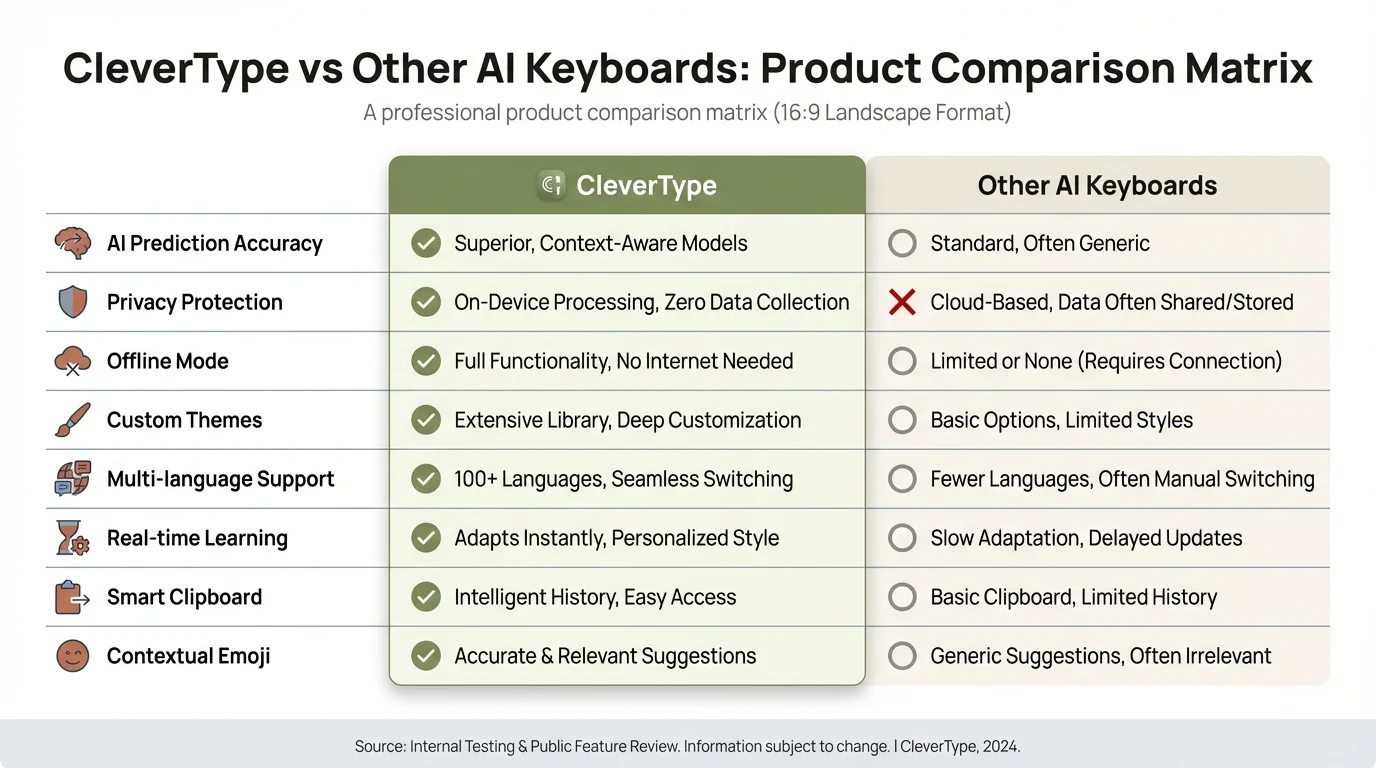
CleverType leads the AI keyboard market with advanced features designed for professional communication
Grammar and Professional Presentation in Text
Let's be real—nothing tanks your professional credibility faster than mixing up "your" and "you're" in an important message. Even small grammar mistakes can make a huge difference in how your messages are received. They signal carelessness at best and incompetence at worst. In an era where first impressions increasingly happen via text, these details matter more than ever.
Recent 2026 workplace communication studies show that 73% of hiring managers now evaluate candidates partly based on their written communication in text-based interviews and messaging platforms. That's up from 68% just two years ago. Harsh? Maybe. But it's the reality of our text-first professional world.
AI grammar correction for mobile devices has become sophisticated enough to catch not just obvious errors but subtle issues like passive voice overuse, overly complex sentences, and even culturally insensitive language. It's like having a professional editor review every text before you hit send.
The beauty is that these tools don't just fix problems—they teach you. Over time, many users report that their natural writing improves because they've learned from the corrections. It's education disguised as convenience!
And it's not just about avoiding negatives. Proper grammar and style create positive impressions too. Messages that are clear, concise, and error-free are more likely to get the response you want, whether that's approval from your boss or buy-in from a client.
"The difference in response rate between my pre-AI messages and now is night and day," says sales consultant Amir Johnson. "People just take you more seriously when your communication is polished."
Tone Adjustment: Finding the Right Voice
Ever sent a message that came across as angry when you meant to be direct? Or maybe too casual when the situation called for formality? Tone is tricky in text, where we lack voice inflection and facial expressions. That's where professional texting tools really shine.
Modern AI keyboards to change tones of sentences offer incredible flexibility. You can write a quick draft and then adjust the tone to match your audience and purpose. Need to sound authoritative for that budget request? Friendly but professional for that client follow-up? Sympathetic for that message to a struggling team member? There's a tone setting for that.
What's fascinating is how these tools analyze the emotional impact of words beyond their literal meaning. They consider cultural context, power dynamics, and even industry-specific norms. For example, what sounds appropriately direct in a tech startup might seem rude in a more traditional industry.
Most people struggle with striking the right balance between being too stiff and too casual in professional texts. AI tone adjustment helps find that sweet spot—professional but human, confident but not arrogant.
"I work with clients across different cultures," explains consultant Maya Wong. "Being able to adjust my tone depending on whether I'm texting a client in Tokyo or Toronto has been game-changing for my international relationships."
The results speak for themselves. Messages with appropriate tone get faster responses and create fewer misunderstandings. They build rapport rather than creating distance.
Time Efficiency and Predictive Text
Who has time to craft perfect messages for every single communication? Not me, and probably not you either. That's why the time-saving aspects of professional texting tools are so valuable in our always-on work culture.
The best AI keyboards for business professional use don't just predict the next word—they understand the context of your conversation and can suggest relevant responses. Starting a meeting confirmation email? The keyboard might suggest "Looking forward to discussing the project tomorrow at 2 PM. Please let me know if that still works for you."
These predictions get spookily accurate over time as the AI learns your common phrases, vocabulary preferences, and communication patterns. Some users report being able to compose entire emails by just selecting from suggestions, with minimal typing.
Templates for common business communications take this even further. Need to send a professional apology for missing a deadline? A polite follow-up after a meeting? There are pre-built frameworks that you can customize in seconds rather than minutes.
"I used to spend at least an hour a day just composing and polishing messages," says executive assistant Taylor Reed. "With my AI keyboard, that's down to maybe 15-20 minutes total. I'm getting the same results with a quarter of the effort."
This efficiency isn't just about saving time—it's about reducing the mental load of communication. When you're not stressing about finding the perfect words for every message, you can focus more energy on the substance of what you're trying to communicate.
In 2026, we're also seeing interesting patterns in how different generations use these tools. While younger professionals use AI keyboards primarily for speed and efficiency, older professionals tend to value the confidence boost—knowing their messages will be grammatically perfect and appropriately toned. Both groups report similar satisfaction levels, which suggests these tools have achieved something rare: broad appeal across age demographics.
Enhancing Non-Native English Speaker Communication
For those who aren't native English speakers, professional texting in English can be particularly stressful. Will that idiom make sense? Is that preposition correct? Am I being too direct or not direct enough for American business culture?
This is where AI grammar keyboards for non-native speakers are truly transformative. They provide culturally aware corrections that consider both grammatical accuracy and cultural appropriateness.
Many of these tools can adapt to different varieties of English too—American, British, Australian, etc.—helping users navigate the subtle differences that might otherwise cause confusion.
Beyond corrections, these keyboards often provide explanations for suggested changes, turning every text into a mini language lesson. Non-native speakers report gaining confidence in their English writing skills much faster when using these tools regularly.
"English is my third language," shares product manager Javier Moreno. "Before using an AI keyboard, I would spend too much time second-guessing every professional message. Now I trust the suggestions, and my colleagues have commented on how much clearer my communication has become."
The impact extends beyond individual messages. Better communication leads to better integration in the workplace, more recognition for ideas, and ultimately, better career opportunities for non-native speakers who might otherwise be held back by language barriers.
Custom Writing Assistants and Personalization
One size definitely does not fit all when it comes to professional communication. A lawyer needs different writing support than a nurse or a software developer. That's why the most sophisticated professional texting tools now offer customization.
AI keyboards with customizable assistants allow you to create specialized helpers for different contexts. You might have one assistant for client communication, another for internal team messages, and a third for technical documentation.
These assistants can be trained on industry-specific terminology, company style guides, and even your personal writing samples to create suggestions that truly sound like you—just the most polished version of you.
Some tools even integrate with your calendar and email to provide context-aware suggestions. Texting about that upcoming project review? Your assistant might pull in relevant deadlines or action items without you having to look them up.
"I've created three different writing assistants," explains marketing director Casey Johnson. "One helps me write engaging social media copy, another helps with data-heavy internal reports, and a third is tuned for client proposals. Each has a distinct voice that's perfect for its purpose."
This level of personalization means that professional texting tools aren't homogenizing communication—they're actually enabling more authentic expression while maintaining professionalism. Your messages still sound like you, just without the mistakes and with less effort.
Privacy and Security in Professional Texting
When we talk about professional texting tools, we can't ignore the elephant in the room: privacy concerns. If an AI is analyzing your messages to provide suggestions, what happens to that data? This is especially important for professionals handling sensitive information.
The good news is that privacy matters have become a primary focus for reputable professional texting tools. Many now offer local processing options where your text never leaves your device. Others have strict data retention policies that limit how long your information is stored.
For industries with specific compliance requirements like healthcare (HIPAA) or finance (SOX), there are specialized tools designed with those regulations in mind. These tools provide documentation of their security measures and are regularly audited for compliance.
End-to-end encryption has also become standard for the transmission of any data that does leave your device. This means that even if the data is intercepted, it can't be read without the proper decryption keys.
"As a financial advisor, I have to be extremely careful about client communications," notes wealth manager Robin Lee. "I chose my AI keyboard specifically because it processes everything locally on my device and has certification for financial industry compliance. In 2026, these privacy features aren't optional anymore—they're essential for anyone handling sensitive information."
The key takeaway? Privacy features should be a major factor in choosing professional texting tools, especially if you work in an industry with strict confidentiality requirements.
What's Next for Professional Mobile Communication in 2026 and Beyond
So where is all this headed in 2026 and beyond? What seemed like sci-fi predictions just two years ago are now everyday realities. Voice-to-professional-text has become remarkably accurate, with tools that can transcribe your rambling thoughts and transform them into polished, professional messages in seconds. Many professionals now dictate rather than type their messages, knowing the AI will clean up the grammar and structure automatically.
Multilingual support has also matured dramatically. Today's tools don't just translate—they culturally adapt your messages. Writing to a business contact in Japan? The AI adjusts not just the language but the level of formality, honorifics, and cultural references to match Japanese business etiquette. It's like having a cultural consultant and translator built into your keyboard.
Integration with other productivity tools has deepened significantly. Modern AI keyboards pull context from your calendar, CRM, project management tools, and previous conversations to provide genuinely helpful suggestions. If you're messaging a client about a project, the keyboard knows the project status, upcoming deadlines, and relevant details without you having to look anything up.
Multimodal communication is another area that's taken off in 2026. These tools now help you seamlessly blend text, images, data visualizations, and even video snippets into your professional messages, maintaining the same level of polish and consistency across all formats. It's not just about words anymore—it's about communicating ideas in whatever format works best.
Perhaps most intriguingly, these tools have become genuinely proactive. They don't just help you respond to messages—they suggest communications you should initiate. "You haven't checked in with Sarah about the Q2 report in two weeks" or "It's been a month since you last contacted this client" are the kinds of helpful nudges that prevent professional relationships from falling through the cracks.
"The contextual awareness in 2026 is incredible," says tech analyst Jordan Rivera. "These tools understand not just what you're saying but why you're saying it and who you're saying it to. They've moved from being spell checkers to being genuine communication partners that make everyone more effective."
Frequently Asked Questions
What makes a text message sound professional?
A professional text message is clear, concise, grammatically correct, and uses an appropriate tone for the recipient and situation. It avoids excessive abbreviations, slang, and emojis (unless appropriate for your industry). Professional texts also include a clear purpose or call to action and maintain appropriate formality without sounding robotic.
Can AI keyboards really improve my professional writing?
Yes! AI keyboards can catch grammar and spelling errors, suggest more appropriate phrasing, adjust tone, and help you write more efficiently. Many users report significant improvements in response rates and perception after adopting AI writing tools. They're particularly helpful when you're writing quickly or in situations where you need to sound more polished than you might naturally type.
Are professional texting tools worth paying for?
It depends on how much professional communication you do on your mobile device. If you frequently email, message, or create content from your phone or tablet, the productivity gains and professional polish can definitely justify the cost. Many users report saving hours each week and experiencing better outcomes from their communications, which can translate to tangible business benefits.
Do these tools work in languages other than English?
Many AI keyboards support multiple languages, though the depth of features varies by language. English typically has the most advanced features, followed by major European and Asian languages. Support for tone adjustment and sophisticated grammar correction in other languages is improving rapidly but may not be as comprehensive as English features yet.
How do I protect my privacy when using AI keyboard apps?
Look for tools that offer local processing options, clear privacy policies, and appropriate certifications for your industry. Read the privacy policy carefully to understand what data is collected and how it's used. Consider using different keyboards for highly sensitive communications versus general professional use if necessary. Some tools also offer "incognito" modes that don't learn from or store your inputs.
Will professional texting tools make everyone sound the same?
Not if you choose tools with good personalization options. The best professional texting tools learn your unique voice and enhance it rather than replacing it. They should help you sound like the most polished version of yourself, not like a generic template. Look for tools that allow you to customize their suggestions to match your personal or brand voice.
How long does it take to get comfortable with an AI keyboard?
Most users report an adjustment period of about 1-2 weeks before they feel fully comfortable with an AI keyboard. The initial learning curve involves trusting the suggestions and finding the right settings for your needs. However, the productivity benefits typically begin immediately, even during the learning phase. Many keyboards offer tutorials and progressively introduce features to make the transition smoother.