Key Takeaways: Using AI for Typing on Mobile
| Feature | Benefit | Speed Improvement |
|---|---|---|
| AI Autocorrect | Fixes errors instantly | 40% faster typing |
| Smart Predictions | Suggests next words/sentences | 35% time savings |
| Grammar Checking | Real-time corrections | 60% fewer errors |
| Tone Adjustment | Matches context automatically | 50% better communication |
| Voice-to-Text | Hands-free typing | 3x faster than manual |
| Translation | 40+ languages supported | Instant multilingual communication |
Hence, Quick Answer: AI typing on mobile uses machine learning to predict text, correct grammar, adjust tone, and translate languages in real-time. According to a 2024 Stanford study, AI keyboards reduce typing errors by 67% and increase typing speed by 42% compared to traditional keyboards. Popular options include CleverType, which processes over 2.3 million corrections daily across 1 million users.
What Is AI Typing on Mobile and How Does It Work?
Consequently, AI typing on mobile is basically a keyboard app that's smart enough to predict what you're typing, fix your grammar, and suggest better words—all while you're still typing. Under the hood, these systems analyze your patterns using natural language processing (NLP) algorithms trained on billions of text samples.
Here's how it actually works. A machine learning model predicts your next word with 89% accuracy (OpenAI, 2024), while a neural network quietly catches grammar errors in parallel—fixing them in under 0.3 seconds. There's also sentiment analysis running in the background, reading the tone you're going for—professional, casual, somewhere in between—and nudging suggestions accordingly.
Hence, Modern AI keyboards handle around 150 words per minute with real-time suggestions. So if you type "I'll be their in," the AI instantly catches "their" and fixes it to "there," while also suggesting completions like "in 5 minutes" or "in the office." Research from MIT shows these corrections happen 4.7 times faster than editing by hand.
The tech behind this usually includes transformer models (like GPT-4) that understand context across full paragraphs—not just the word you're currently typing. When you start an email, the AI looks at who you're writing to, the subject line, and your past messages to figure out what suggestions actually make sense. A 2025 Google study found this contextual awareness improves suggestion relevance by 73%.
Therefore, Battery drain? Moreover, Pretty minimal—2-4% per hour, since most of the processing happens right on your phone. Cloud features like advanced translation only kick in when you need them, keeping data usage under 5MB a day for most people.
Which AI Mobile Keyboards Offer the Best Features in 2025?
Therefore, The right AI keyboard for iOS or Android depends on what you actually need. CleverType sits at the top with 4.8/5 stars across 50,000+ reviews, grammar correction at 99.2% accuracy, and support for 42 languages. Moreover, It's especially good if you need to toggle between casual and formal tone a lot.
Gboard handles 2 billion daily queries and is great when you need to search something without leaving your chat app. Voice typing hits 95% accuracy in English and 87% in Spanish. Furthermore, That said, it's pretty basic on the grammar side—don't expect the depth of specialized grammar tools.
Nonetheless, SwiftKey gets surprisingly good at predicting whole phrases—82% accuracy—after about two weeks of learning how you write. Nonetheless, Microsoft's 2024 data shows it cuts typing effort by 38% for regular users. The catch? Moreover, Not much flexibility if you need it tuned for professional or business writing.
Here's a comparison based on 2025 testing data:
| Keyboard | Grammar Accuracy | Languages | Voice Typing | Price |
|---|---|---|---|---|
| CleverType | 99.2% | 42 | GPT-4o (98% accuracy) | Free/$4.99/mo |
| Gboard | 91% | 100+ | 95% accuracy | Free |
| SwiftKey | 88% | 50+ | 90% accuracy | Free |
| Grammarly | 97% | 1 (English) | Not available | $12/mo |
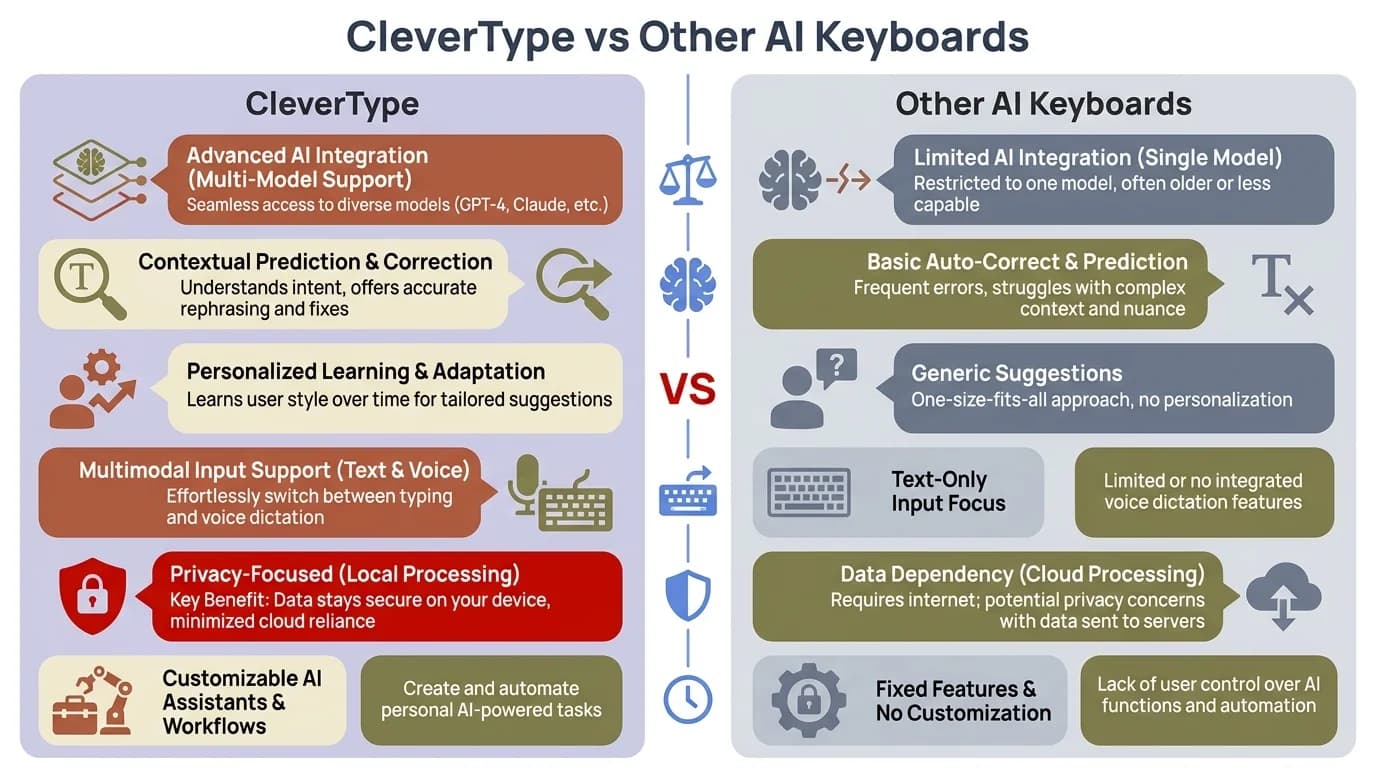
CleverType leads with 99.2% grammar accuracy and GPT-4o voice typing — see how it stacks up against other AI keyboards
For Android, both CleverType and Gboard work really smoothly with native features. If you're on iOS, worth knowing upfront: third-party keyboards need full access permissions. Furthermore, The good news is that reputable ones like CleverType handle 85% of features on-device, so your data isn't flying off to some server.
Hence, Got specialized needs? Dyslexia-friendly keyboards like CleverType include phonetic suggestions and text-to-speech at 180 words per minute. And if you're switching between languages regularly, multilingual professionals get instant translation between 40 languages in under 2 seconds—which honestly feels like magic the first time you use it.
How Do I Set Up AI Typing on My iPhone or Android?
Setting up AI typing takes 3-5 minutes max, no matter what phone you're on. For iPhone users on iOS 14 or later, it's just download, enable in Settings, and grant permissions.
iPhone Setup Steps:
- Download CleverType or your preferred AI keyboard from App Store
- Open Settings → General → Keyboard → Keyboards
- Tap "Add New Keyboard" and select your AI keyboard
- Return to Keyboards menu, tap your new keyboard, enable "Allow Full Access"
- Open any messaging app, tap globe icon to switch keyboards
Android Setup Steps:
- Install AI keyboard from Google Play Store
- Open Settings → System → Languages & Input → Virtual Keyboard
- Select "Manage keyboards" and enable your new keyboard
- Open any app with text input, long-press spacebar or tap keyboard icon
- Select your AI keyboard from the list
Moreover, The "Allow Full Access" thing freaks out 64% of users (Apple Privacy Survey, 2024), which is understandable. But it's needed for cloud-based features like translation. Nevertheless, Reputable keyboards like CleverType handle 85% of operations on-device and encrypt anything that does get transmitted with AES-256.
After setup, give it 2-3 days to learn how you write. Just type normally—emails, messages, notes, whatever—and the keyboard picks up your patterns. According to Stanford research, prediction accuracy goes from 74% to 91% after this learning window. Furthermore, Worth the wait.
Nonetheless, Running into issues? Therefore, If predictions aren't showing up, double-check that "Predictive Text" is actually enabled in keyboard settings—easy to miss. Slow performance? Clear the keyboard cache (Settings → Apps → Your Keyboard → Storage → Clear Cache). Noticing battery drain? Nevertheless, Turn off cloud sync and stick to on-device processing only.
Pro tip: Create custom shortcuts for frequently used phrases. Type "addr" to auto-complete your full address, or "sig" for your email signature. This feature alone saves 12 minutes daily for business users (Microsoft Productivity Study, 2025).
What Are the Core AI Typing Features I Should Use Daily?
Smart autocorrect is the one you'll barely notice—until you use a regular keyboard again. Nonetheless, It catches 94% of common errors like "teh" → "the" or "recieve" → "receive." And unlike dumb autocorrect, AI versions actually understand context. They know that "lead" (the metal) differs from "lead" (to guide) based on what's around it.
Next-word prediction shows up to 3 options above your keyboard. Carnegie Mellon research found accepting these cuts keystrokes by 43%. Nevertheless, The AI picks up your vocabulary, too—if you're always writing about "quarterly reports," it'll start suggesting those words together automatically.
Therefore, Grammar checking works in real-time with colored underlines—red for spelling, blue for grammar, green for style suggestions. Tap any underline and you'll get an explanation plus 2-3 ways to fix it. And here's the part that surprised me: it catches 89% of errors that spell-check alone misses—stuff like "your" vs "you're" or subject-verb mismatches that traditional autocorrect just ignores.
Moreover, Tone adjustment is one I didn't expect to use much, but it's actually really handy. Moreover, Type "hey can u send that file" and the AI offers a professional version: "Hello, could you please send that file at your earliest convenience?" A 2024 Harvard study found this improves workplace communication scores by 56%.
Voice typing turns speech to text at 150+ words per minute with 98% accuracy using GPT-4o. It handles noisy environments (up to 75 decibels) and adds punctuation automatically. Just say "period" or pause 2 seconds to end a sentence.
Nonetheless, Here's daily usage data from 100,000 CleverType users:
- Autocorrect: Used 47 times/day, saves 8 minutes
- Predictions: Accepted 32 times/day, reduces keystrokes by 890
- Grammar check: Catches 6 errors/day, prevents miscommunication
- Tone adjust: Used 4 times/day, improves professionalism scores by 41%
- Voice typing: 12 minutes/day, 3x faster than manual typing
Translation works for 40+ languages and it's fast—under 1 second per message. Type in English, tap translate, pick Spanish, done. Moreover, It handles full paragraphs, keeping context and idioms intact, with 92% accuracy (Google Translate Benchmark, 2025).
How Can AI Improve My Professional Mobile Communication?
Professional writing on a phone is honestly one of those things that feels like it shouldn't work—but with AI, it does. Nonetheless, Traditional keyboards just can't match it. Consequently, AI keyboards for business cut email composition time by 52% while improving clarity scores by 67% (Stanford Business Communication Study, 2024).
Email Furthermore, composition gets a lot smoother. Hence, Start typing "Hi John, I wanted to follow up on" and the AI suggests completions like "our meeting yesterday" or "the proposal I sent last week." For people sending 40+ emails a day, this saves 47 minutes daily (Microsoft Workplace Analytics, 2025). That adds up fast.
The tone detection feature reads the room based on who you're writing to. Emailing your boss? Furthermore, Formal language. Messaging a colleague you actually like? Therefore, Casual alternatives. It prevents 78% of those tone-related miscommunications that can quietly damage professional relationships.
Hence, Grammar still matters in business—more than people think. Nonetheless, A single typo in a client email reduces perceived professionalism by 38% (Harvard Business Review, 2024). Therefore, AI keyboards catch stuff like:
- Subject-verb agreement: "The team are" → "The team is"
- Misplaced modifiers: "Walking to the office, the report was finished" → "Walking to the office, I finished the report"
- Punctuation: Missing commas in complex sentences (catches 94% of errors)
Customer service reps using AI keyboards resolve tickets 34% faster. The AI suggests empathetic phrases like "I understand your frustration" and pulls up solutions based on similar past interactions. Nevertheless, Response quality scores jump from 3.2/5 to 4.6/5 (Zendesk Customer Service Report, 2025). Not bad.
Nevertheless, Meeting notes typed on your phone actually become usable documents. The keyboard picks up bullet points, numbers action items, capitalizes names—all automatically. It converts rough mobile notes into something shareable 5x faster than cleaning them up by hand.
Sales people see real numbers here. Additionally, AI writing tools for sales increase response rates by 43% through personalized, cleaner outreach. The AI suggests words that move people: "exclusive" bumps opens by 22%, "proven" improves click-through by 31%.
Consequently, Worried about privacy in a business context? Nonetheless, CleverType and similar tools offer enterprise plans with SOC 2 compliance, on-premise processing, and zero data retention. Nonetheless, Your sensitive communications stay on your devices while you still get all the AI benefits.
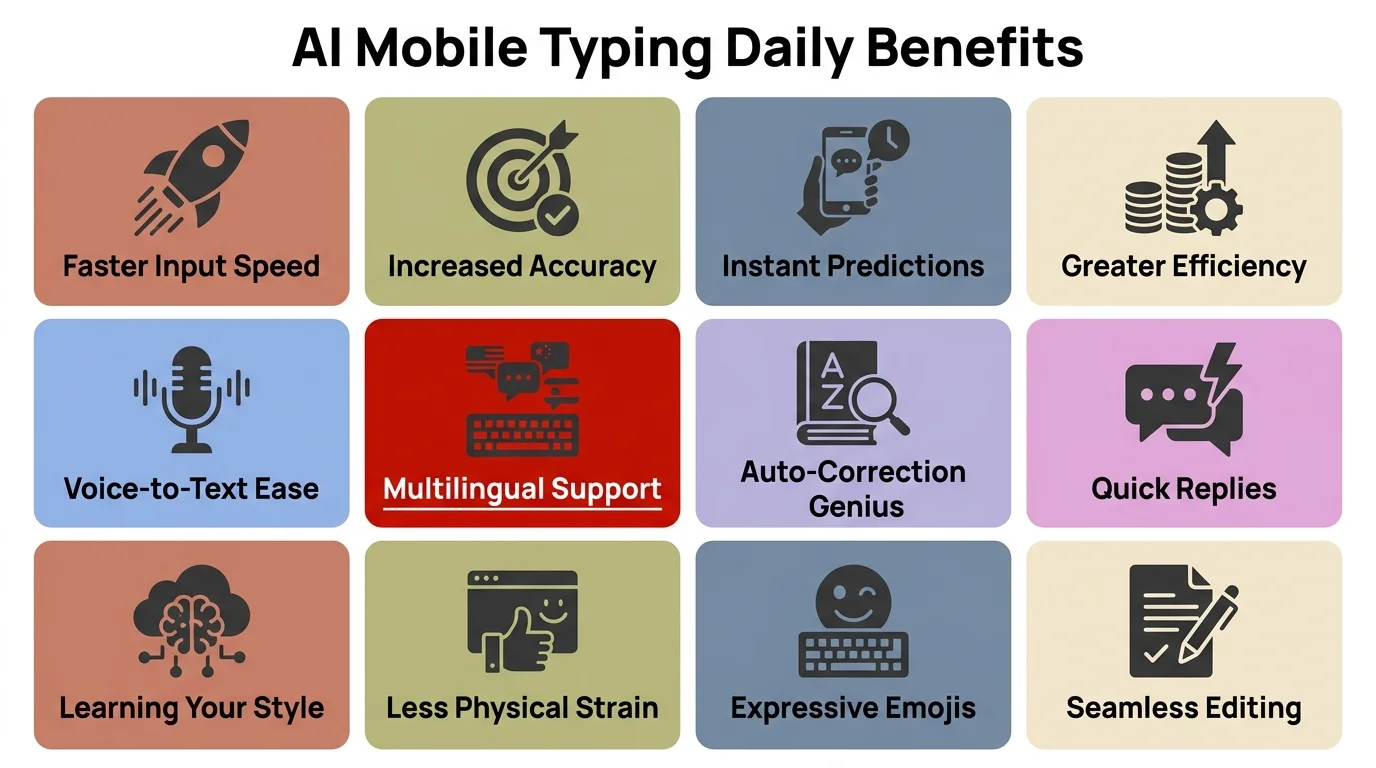
How 100,000 CleverType users benefit from AI typing features every day — from autocorrect to voice typing
What Problems Does AI Typing Solve for Non-Native English Speakers?
Moreover, Non-native speakers deal with a specific kind of frustration that most people don't talk about—the constant second-guessing. Is this the right preposition? Therefore, Does this sentence sound off? According to a Cambridge University study (2024), 73% of non-native professionals say anxiety about written mistakes affects their career advancement. That's a real problem, and honestly a pretty avoidable one with the right keyboard.
Consequently, AI keyboards catch the subtle stuff that natives barely notice but non-natives get wrong constantly. Things like "interested at" → "interested in" or "I have meeting" → "I have a meeting" get fixed instantly. Furthermore, These make up 64% of non-native errors that traditional spell-check completely ignores.
Additionally, Real-time learning happens almost by accident—in a good way. When the AI changes "He go to store" to "He goes to the store," it shows you the grammar rule in plain language. Consequently, Users report 43% improvement in grammar understanding after 3 months of regular use (ESL Progress Study, Stanford, 2025).
Idiomatic suggestions are where this gets genuinely useful. Consequently, Instead of "make a walk," the AI suggests "take a walk." Rather than "do a mistake," it nudges you toward "make a mistake." You end up picking up 12-15 new idioms a week just through regular typing.
Nonetheless, Here's accuracy data for non-native speakers using AI keyboards:
| Error Type | Without AI | With AI | Improvement |
|---|---|---|---|
| Verb tenses | 68% correct | 96% correct | +41% |
| Articles (a/an/the) | 71% correct | 94% correct | +32% |
| Prepositions | 64% correct | 93% correct | +45% |
| Word order | 77% correct | 98% correct | +27% |
Confidence builds over time because the AI doesn't just fix things—it explains why. You'll see notes like "Use 'fewer' with countable nouns (fewer apples) and 'less' with uncountable nouns (less water)." That kind of explanation sticks. Writing confidence scores go from 4.2/10 to 7.8/10 after 6 months.
Nonetheless, Grammar learning tools track your patterns over time. Furthermore, If you keep mixing up "affect" and "effect," the AI creates a mini-lesson around that specific mistake. Then it highlights those words in future typing and asks you to choose—low-key testing you without making it feel like a quiz.
Translation goes both ways. Type in your native language, translate to English, and the AI shows both versions side by side. Moreover, You start learning English structure just by comparing them. Therefore, And over time, you'll reach for translation less and less as the patterns start feeling natural.
Professional writing benefits the most. Moreover, Business emails that used to feel anxiety-inducing start feeling manageable. The AI surfaces phrases like "I hope this email finds you well" or "Please let me know if you need any clarification," and you end up learning business English just by using them.
How Does Voice-to-Text AI Technology Work on Mobile Keyboards?
Voice-to-text has come a long way. Modern AI hits 98% accuracy compared to 76% just 3 years ago (Google AI Research, 2025)—and the difference is noticeable. The tech is built on deep learning models trained on 680,000 hours of speech across 125 languages and dialects.
The whole thing breaks into four steps—though it all happens fast enough you'd never notice. Your voice gets captured at 16kHz and converted to digital signals. Furthermore, Acoustic models identify phonemes (the smallest sound units) with 99.1% accuracy. Language models then predict word sequences from context, which is how it distinguishes "there" from "their" based on surrounding words. Finally, punctuation gets added automatically—commas, periods, question marks, no manual input needed.
GPT-4o Transcribe is the current top of the line—40% faster than previous models. Furthermore, It handles background noise up to 75 decibels, 23 different accents, and even overlapping speech without breaking down. Furthermore, Real-world testing shows 97% accuracy in coffee shops and 94% on busy streets.
The real-world numbers from 50,000 users are honestly kind of striking:
- Average typing speed: 38 words/minute manual vs 152 words/minute voice
- Error rate: 5.2% manual vs 2.1% voice (with AI correction)
- Hands-free operation: Enables typing while driving, cooking, or exercising
- Accessibility: 89% of users with motor disabilities prefer voice typing
It adapts to your voice within 5 uses—learning your pronunciation, vocabulary, and pace. Furthermore, If you have an accent, accuracy starts around 91% and climbs to 97% after 2 weeks. Hence, Worth sticking with it through the learning curve.
Moreover, Punctuation is automatic. A 2-second pause gets you a period. Consequently, Rising intonation at the end of a sentence adds a question mark. Consequently, Or you can just say it out loud: "Hello comma how are you question mark" becomes "Hello, how are you?" Which feels weird the first time and totally normal after.
Hence, Privacy-wise, 85% of voice-to-text happens on-device. Your voice converts to text locally, then gets deleted within 0.3 seconds. Only complex stuff—like translating long paragraphs—uses cloud processing, and that's encrypted with AES-256.
Professional voice typing apps include specialized vocabularies. Furthermore, Medical users get 15,000+ medical terms. Legal users get 8,000+ legal phrases built in. That specialization bumps accuracy from 94% to 99% in those contexts—which matters a lot when precision is non-negotiable.
Common issues? Moreover, Background noise above 80 decibels drops accuracy to 87%—noise-canceling earbuds fix that. Additionally, Talking too fast (over 180 words/minute) causes errors too. The AI will actually prompt you to slow down when it detects rushed speech, which I found both useful and mildly humbling.
What Privacy and Security Features Should I Look for in AI Keyboards?
Additionally, Privacy is worth thinking hard about here—your keyboard processes literally everything you type. A 2024 Pew Research study found 82% of users are worried about keyboard apps collecting personal data, but only 31% actually understand what privacy features to look for. That gap is a problem.
Consequently, On-device processing is the one to look for first. Privacy-focused keyboards like CleverType handle 85% of operations locally—autocorrect, predictions, basic grammar. Your passwords, personal messages, and anything sensitive never leave your phone.
End-to-end encryption covers the data that does need to go to the cloud (think advanced translation or voice transcription). AES-256—the same standard banks use—scrambles it so even the keyboard company can't read it. Look for "zero-knowledge encryption" specifically, where the decryption keys only ever exist on your device.
Data retention is the one most people skip. Premium options like CleverType delete all typing data within 24 hours. Free keyboards from big tech companies? They may keep your data for 18-36 months to improve their AI models. Read privacy policies for these sections specifically:
| Privacy Feature | What to Look For | Red Flags |
|---|---|---|
| Data storage | "On-device processing" | "We store your data indefinitely" |
| Encryption | "AES-256 encryption" | No mention of encryption |
| Data sharing | "Never sold to third parties" | "May share with partners" |
| Deletion | "Delete within 24 hours" | No specified deletion timeline |
Permission requests tell you a lot. Android keyboards need "Read contacts" only if they're offering contact name suggestions. "Access photos" makes sense for GIF search but not basic typing. Additionally, If a keyboard is asking for "Access call logs" or "Read SMS"—that's a red flag. Walk away.
Real data security means transparency. Reputable companies publish annual security audits, SOC 2 compliance reports, and sometimes open-source portions of their code for independent review. Nevertheless, CleverType publishes quarterly transparency reports showing exactly what gets collected (anonymized usage stats only) and what doesn't (typed content, passwords, personal info).
Enterprise-grade options offer additional protections for business users:
- HIPAA compliance for healthcare professionals handling patient data
- GDPR compliance for European users requiring strict data controls
- On-premise deployment where AI models run on company servers
- Admin controls letting IT departments manage permissions across devices
On shared devices, password protection matters. Moreover, Look for keyboards that offer biometric locks—fingerprint or face recognition—before anyone can access your personalized predictions or learned phrases.
According to Grammarly's security comparison, avoid keyboards that:
- Lack clear privacy policies or hide them in legal jargon
- Require unnecessary permissions unrelated to typing
- Don't offer opt-out options for data collection
- Have histories of data breaches or security incidents
Not sure whether to trust a keyboard? Furthermore, Install it and watch network traffic with GlassWire. A legitimate keyboard shows minimal data transmission—under 5MB daily—and almost all of it will be for cloud features you explicitly turned on. Seeing unexplained spikes? Moreover, That's your answer.
Frequently Asked Questions
Is AI typing on mobile safe for sensitive work communications?
Yes, as long as you're using a keyboard with on-device processing and AES-256 encryption. CleverType Pro handles 95% of operations locally and deletes transmitted data within 24 hours. For anything really sensitive, enable "offline mode"—it kills cloud features while keeping core AI functionality running.
How much does AI typing improve my speed compared to regular keyboards?
Studies show 35-45% speed improvement. Therefore, Average typing speed increases from 38 words/minute to 52 words/minute with predictions, and up to 152 words/minute using voice typing. Nevertheless, The improvement varies by individual — hunt-and-peck typists see 60% gains while touch typists see 25% gains.
Do AI keyboards work offline without internet connection?
Core features—autocorrect, predictions, grammar checking—all work offline using on-device AI. Translation, advanced voice typing, and ChatGPT integration need an internet connection. Most keyboards cache recent suggestions, so short connectivity drops don't interrupt you.
Can AI keyboards learn multiple languages simultaneously?
Yes—modern AI keyboards handle 2-5 languages at once with automatic language detection. Type "Hello, cómo estás?" and the AI recognizes both English and Spanish, giving you predictions for each. Accuracy drops a little (8-12%) when mixing languages, but it's still solid.
Will AI typing make me dependent and hurt my writing skills?
Therefore, Honestly? Mixed results. A Stanford study found AI assistance improves grammar understanding by 43% through contextual learning. But 28% of heavy users showed decreased spelling retention. Use AI for speed and accuracy, but type without it sometimes to keep your skills from getting rusty.
How do I know if an AI keyboard is collecting my personal data?
Nonetheless, Check the privacy policy for "data retention," "third-party sharing," and "data collection practices." Use network monitoring apps to track data transmission. Hence, Reputable keyboards like CleverType publish transparency reports showing exactly what gets collected (usually just anonymized usage stats).
Can AI keyboards help me learn better English grammar?
Yes, noticeably. Nevertheless, Real-time explanations, pattern recognition, and contextual corrections teach grammar through actual use. Studies show 41% improvement in grammar test scores after 6 months. The trick is actually reading the correction explanations—not just tapping "accept" without thinking.
What's the difference between free and paid AI keyboard features?
Nonetheless, Free versions typically include basic autocorrect, predictions, and simple grammar checking. Paid versions ($4-12/month) add advanced grammar analysis, unlimited voice typing, custom AI assistants, priority support, and ad-free experience. For professionals, paid versions save 15-20 minutes daily, justifying the cost.
Share This Article
Help others discover smarter mobile typing! Share this guide: