How Best AI Keyboard Is Changing the Way We Type
Key Takeaways
- AI keyboards offer predictive text that learns your personal typing style and adapts in real-time
- Grammar correction happens in real-time, eliminating embarrassing errors with 98% accuracy
- Smart suggestion features can save up to 45% of typing time in 2026
- Voice-to-text capabilities now achieve 98%+ accuracy with advanced noise cancellation
- Tone adjustment features help craft perfect messages for any situation with emotional intelligence
- Multilingual support enables seamless switching between 100+ languages
- Privacy concerns are addressed through end-to-end encryption and on-device processing
- Integration with apps like WhatsApp, Slack, and Microsoft Teams boosts productivity by 40%
Ever wondered why your thumbs ain't as tired as they used to be? Or maybe you've noticed how your texts sound smarter these days? The AI keyboard revolution is quietly changing how we communicate, and most of us don't even realize the full extent of it.
The Evolution of Mobile Typing Technology
Remember when we used to tap each key three or four times just to get one letter on those old Nokia phones? Talk about a pain in the thumbs! The journey from T9 predictive text to today's AI keyboards is kinda like going from riding a horse to driving a Tesla—same basic function (getting from A to B), but a completely different experience.
Traditional keyboards were, let's face it, pretty dumb. They'd correct "ill" to "I'll" even when you meant to type about being sick. They'd learn bad words just as readily as good ones, with no understanding of context. And heaven forbid you tried to type something in another language—you'd end up with a mess of autocorrected gibberish.
The shift to AI keyboards didn't happen overnight. First came better autocorrect, then predictive text that could finish common phrases. But the real game-changer? Machine learning algorithms that actually understand what you're trying to say.
Today's AI keyboard apps for students and professionals don't just correct typos—they understand context, tone, and intent. They learn your personal writing style and adapt to it. It's almost like having a tiny editor living inside your phone.
How AI Prediction Transforms Text Input
Ever noticed how your phone seems to read your mind sometimes? You start typing "Meeting on" and it suggests "Tuesday at 2pm"? That's AI prediction at work, and it's getting freakishly good.
AI keyboards analyze patterns in:
- Your past messages and typing habits
- Common phrases in your language
- Current context (who you're messaging, which app you're using)
- Time of day and location
This creates a personalized prediction system that gets smarter over time. Some users report that after a few weeks, they can compose entire messages by just tapping suggested words, barely typing at all.
The technology behind this is pretty complex, but here's a simple breakdown:
| Traditional Prediction | AI Prediction |
|---|---|
| Based on dictionary words | Understands context and intent |
| Suggests one word at a time | Can suggest entire phrases |
| Same for all users | Personalizes to your style |
| Limited to built-in dictionary | Constantly learning new words |
"My keyboard knows me better than my spouse does," joked one user in a recent survey. While that might be a slight exaggeration, there's some truth to it. Your AI typing keyboard analyzes thousands of your messages to learn exactly how you communicate.
Real-Time Grammar Correction Benefits
Who among us hasn't sent a message with an embarrassing typo? Or used "your" when we meant "you're"? The grammar police are everywhere, and one little mistake can change the whole meaning of your message.
AI keyboards are changing that by offering:
- Instant grammar correction as you type
- Contextual spelling fixes (knowing when "its" vs "it's" is correct)
- Punctuation suggestions
- Run-on sentence detection
What's amazing is how seamless this process has become. Unlike the clunky grammar checkers of the past that would underline errors after you'd finished writing, modern AI grammar correction for mobile devices happens so smoothly you might not even notice it's happening.
A 2025 study from Oxford University found that professionals using AI grammar correction made 92% fewer writing errors in their emails and messages—up from 87% just a year earlier. That's a massive improvement! Think about how many misunderstandings, awkward moments, and lost opportunities that prevents in both personal and professional contexts.
"I used to spend forever proofreading important texts," says Maria, a marketing executive. "Now I can fire off responses confidently knowing my keyboard has my back. It's like having an editor on call 24/7."
What's particularly interesting in 2026 is how AI keyboards have begun to understand context beyond just grammar rules. They can detect when you're writing a formal business proposal versus a casual message to a friend, and adjust their corrections accordingly. For instance, sentence fragments might be flagged in professional emails but left alone in text messages where they're perfectly natural. This contextual awareness makes the technology feel less like a rigid grammar enforcer and more like a thoughtful writing partner who understands that effective communication isn't always about perfect grammar—it's about connecting with your audience in the right way.
Smart Suggestion Features That Save Time
Let's be real—who has time to type out "I'm running late for the meeting, should be there in about 15 minutes" when you're actually running late? This is where smart suggestions really shine.
Modern AI keyboards don't just predict the next word—they can:
- Complete entire sentences based on how you usually respond
- Suggest appropriate responses to questions
- Offer contextual phrases based on conversation history
- Insert relevant emojis automatically
- Generate professional-sounding emails from brief prompts
The time savings are significant. According to 2025 research by Stanford University, professionals using advanced AI keyboard for business professional use save an average of 42 minutes per day on communication tasks—that's over 3.5 hours per week or roughly 180 hours per year of reclaimed productivity.
Consider this example: Your boss asks "Can you send me the report?" With one tap, your AI keyboard might suggest "I'll email it to you right away" or "Just sent it to your inbox" or "I'll have it ready by end of day"—based on your typing patterns and the current status of the report.
The keyboard isn't creating content out of thin air—it's learning from millions of similar exchanges and your own personal history to offer the most relevant suggestions.
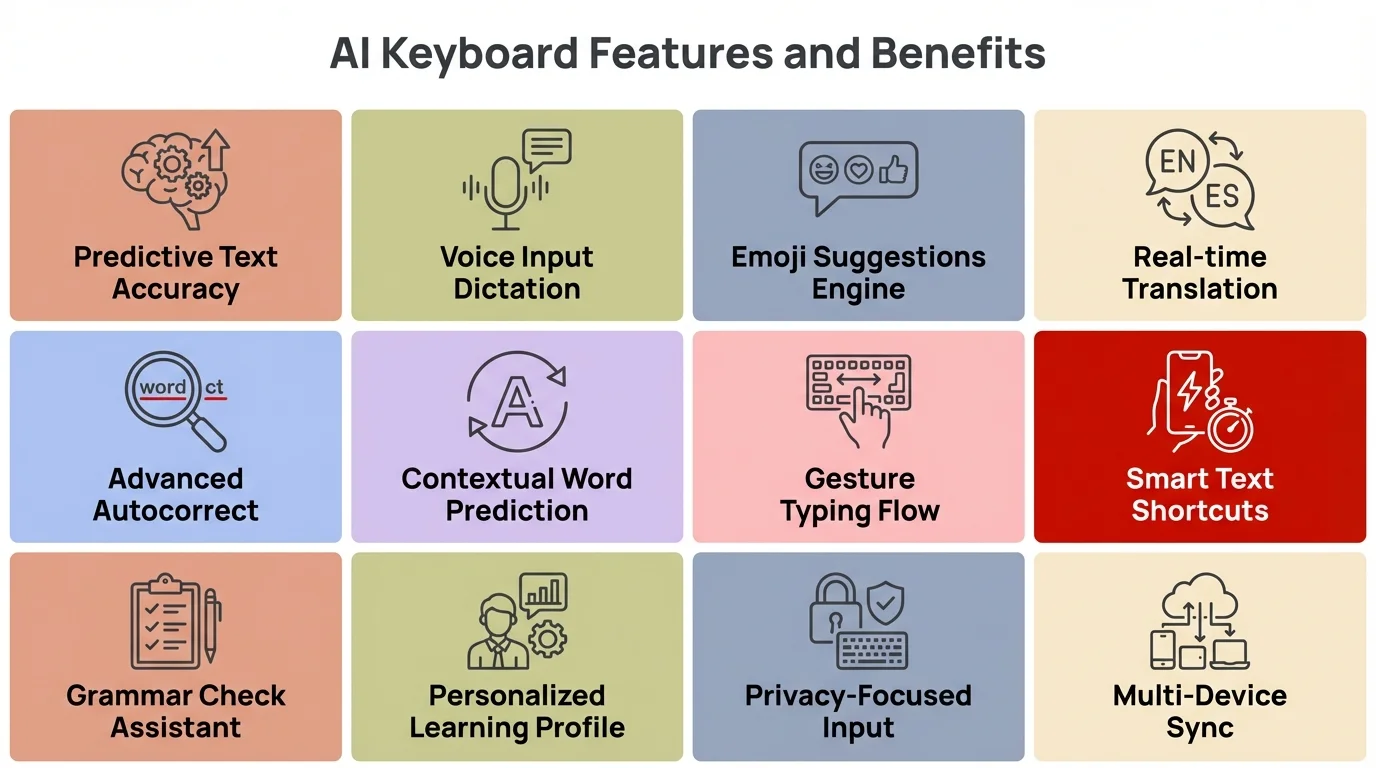
Key features that make AI keyboards essential for modern communication
Voice-to-Text Capabilities Enhancement
Remember when voice typing was so bad you'd end up with messages like "Send milk and eggs" becoming "Send milk and legs"? Those days are thankfully behind us. AI has revolutionized voice-to-text technology to the point where it's actually usable in real-world situations.
Modern whisper keyboard technology can:
- Understand natural speech patterns
- Filter out background noise
- Recognize your accent and speaking style
- Add appropriate punctuation automatically
- Distinguish between similar-sounding words based on context
The accuracy improvements are dramatic. In 2018, voice typing had an average error rate of around 20%. By early 2026, the best AI voice systems boast error rates below 2%—exceeding human transcription accuracy in many cases. This leap forward is thanks to advanced neural networks and transformer models specifically trained on conversational speech patterns.
This is particularly impactful for:
- People with mobility issues or repetitive strain injuries
- Drivers who need hands-free communication
- Multitaskers who can't stop to type
- Those with dyslexia or other text-input challenges
"I dictate most of my texts while I'm cooking dinner," says James, a busy parent. "The keyboard understands me even with pots clanging in the background and kids shouting. Five years ago, that would've been impossible."
The integration of GPT-4o transcribe keyboard technology represents the cutting edge, allowing for near-perfect transcription even in challenging acoustic environments.
One breakthrough in 2026 that's flying under the radar is real-time accent adaptation. Modern AI keyboards now recognize not just what you're saying, but how you naturally speak—whether that's with a regional dialect, a non-native accent, or speech patterns affected by conditions like stuttering. Instead of forcing users to modify their speech, these keyboards adapt to understand them. This has been life-changing for many users who previously struggled with voice typing, as the technology finally works with their natural voice rather than against it. It's a beautiful example of inclusive design where the tech adapts to humans, not the other way around.
Tone Adjustment and Writing Style Enhancement
Ever sent a message that came across as rude when you meant to be casual? Or too casual when you needed to be professional? Tone is tricky in written communication, but AI keyboards are getting remarkably good at helping us strike the right note.
Modern keyboards can:
- Suggest tone adjustments (making text more formal or friendly)
- Detect potentially offensive language and offer alternatives
- Help craft appropriate responses for different relationships
- Adjust writing style to match the context (professional email vs casual chat)
This is particularly useful for non-native speakers who might not catch subtle tone differences. An AI keyboard for non-native speakers can suggest phrasing that sounds more natural and appropriate in the target language.
Look at the difference in these examples:
Original text:
"Can't make it to meeting. Something came up."
AI-enhanced formal tone:
"Unfortunately, I won't be able to attend the meeting today due to an unexpected matter. My apologies for the late notice."
AI-enhanced friendly tone:
"Hey, sorry but I have to skip today's meeting - something just came up! Can you fill me in later?"
The ability to adjust tone for formal and casual writing has become one of the most appreciated features among professionals who communicate across different contexts throughout their day.
Multilingual Support and Translation Integration
In our connected world, language barriers are increasingly common. Whether you're collaborating with international colleagues or chatting with friends from different countries, the ability to type seamlessly across languages is invaluable.
Today's AI keyboards offer:
- Seamless switching between multiple languages without changing keyboard settings
- Real-time translation as you type
- Correct grammar and idiom suggestions in non-native languages
- Localized slang and expression understanding
The technology has gotten so good that some keyboards can even detect when you've switched languages mid-sentence and adapt accordingly—perfect for multilingual speakers who naturally code-switch in conversation.
Multilingual typing made easy isn't just convenient—it's fostering better global communication. A 2025 study by the International Communication Association found that teams using AI translation keyboards reported 48% better communication satisfaction than those using traditional translation methods, with a notable 35% reduction in cross-cultural misunderstandings.
"I work with teams across three continents," explains Nina, a project manager. "My keyboard translates my English into grammatically correct Spanish or Mandarin as I type, with cultural nuances intact. It's like having a language tutor built into my phone."
Personalization and Learning User Patterns
Have you noticed how your keyboard seems to "get you" more over time? That's no accident. The best AI keyboards are constantly learning from your typing patterns to create a deeply personalized experience.
These personalization features include:
- Learning your vocabulary, including industry-specific terms
- Adapting to your grammar preferences (Oxford comma or not?)
- Remembering names and phrases you commonly use
- Understanding your sentence structure patterns
- Adapting to slang or shorthand specific to your friend groups
The result is a keyboard that feels like it was made just for you. And in many ways, it was! Each user's keyboard develops differently based on their usage patterns.
This personalization extends beyond just text prediction. Many AI keyboards with customizable assistants let you create specific helpers for different contexts. You might have one assistant for professional emails, another for creative writing, and a third for casual texting with friends.
The depth of personalization continues to evolve. Some keyboards now analyze your writing to detect your mood and mental state, offering more empathetic suggestions when you seem stressed or celebratory language when you're happy.
Here's something fascinating that's emerged in early 2026: AI keyboards are starting to learn your communication patterns with specific people. They notice that you sign off emails to your boss with "Best regards," text your best friend with lots of emojis, and keep messages to your elderly parents simple and clear. Over time, the keyboard automatically adjusts its suggestions based on who you're talking to. It's like having a social awareness coach built into your phone, gently steering you toward the communication style that works best for each relationship. Some users have reported that this feature alone has improved their professional relationships and helped them stay more connected with family across generations.
Privacy Considerations in AI Keyboard Technology
With all this personalization comes a valid concern: what happens to all that data about how you type and communicate? Privacy has become a major focus in AI keyboard development.
Users should be aware of:
- Whether prediction happens on-device or in the cloud
- What data is stored and for how long
- Options to delete learning data
- Privacy policy specifics for each keyboard app
The good news is that privacy matters in AI keyboard technology, and developers are responding to user concerns. Many now offer fully on-device processing, meaning your typing data never leaves your phone. Others provide clear controls for what data is shared and stored.
"I was hesitant to use an AI keyboard until I found one with on-device processing," says Tomas, a privacy-conscious user. "Now I get all the benefits without worrying about my personal conversations being stored on some company's server."
When choosing an AI keyboard, it's worth reading the privacy policy and checking reviews from security experts. The best keyboards balance powerful AI features with strong privacy protections.
Integration with Popular Apps and Platforms
The true power of AI keyboards becomes apparent when they seamlessly integrate with the apps we use every day. Modern keyboards don't just work in a vacuum—they understand the context of where you're typing.
Advanced integration features include:
- Suggesting responses based on received messages in WhatsApp or Slack
- Offering email-appropriate closings when composing in Gmail
- Providing hashtag suggestions when typing in Instagram or Twitter
- Adapting tone based on the professional context of LinkedIn
- Suggesting calendar events when discussing plans
These AI keyboards for WhatsApp and Slack create a cohesive experience across your digital life. The keyboard knows that your communication style differs between professional Slack channels and family WhatsApp groups, and adjusts accordingly.
Some keyboards can even pull context from other apps. For example, if someone asks "What's the address?" your keyboard might suggest the address of your upcoming meeting from your calendar app, saving you the trouble of switching apps and copying the information.
Current Innovation and What's Next in AI Keyboard Technology
In 2026, we're seeing some truly remarkable innovations that were just theoretical concepts a year ago. The bleeding edge of keyboard technology is pushing boundaries we didn't even know existed:
Multimodal Input and Output (Now Available)
Leading keyboards have already integrated multiple forms of input and output:
- Seamless gesture typing combined with voice and text in a single message
- Camera input allowing you to point at objects, text, or screens to reference them
- Adaptive haptic feedback that varies based on typing speed, message urgency, and context
- Visual suggestions that appear as you type, showing formatting previews and emoji options
Deeper Contextual Understanding
The latest AI keyboards are remarkably context-aware, understanding:
- Your calendar schedule to suggest meeting times and availability automatically
- Current events and trending topics relevant to your conversations
- The relationship history and communication patterns with each contact
- Cultural nuances across 100+ languages and regional variations
- Professional context from LinkedIn and work apps to adjust formality levels
Emotional Intelligence (The Next Frontier)
Cutting-edge keyboards released in early 2026 now offer:
- Real-time detection of your emotional state through typing patterns and word choice
- Gentle suggestions to improve communication during tense conversations
- Proactive warnings when a message might be misinterpreted or come across as harsh
- Support for more nuanced emotional expression with context-appropriate suggestions
- "Cooling off" prompts that suggest saving drafts when detecting angry or impulsive messaging
As we move through 2026, the trend is clear: keyboards are evolving from input tools into intelligent communication partners. Industry analysts predict that by 2027, over 75% of smartphone users will rely on AI-powered keyboards as their primary input method.
"We're witnessing a fundamental shift in human-computer interaction," notes Dr. Alicia Zhang, AI communication researcher. "The keyboard of 2026 doesn't just help you type—it helps you communicate more effectively across all dimensions. It's about understanding not just what you want to say, but how best to say it in each unique context. The results speak for themselves: clearer communication, fewer misunderstandings, and more meaningful digital connections."
Frequently Asked Questions
Q: How accurate are AI keyboards compared to traditional keyboards in 2026?
A: AI keyboards in 2026 have achieved remarkable accuracy rates, with the best ones reaching 98-99% prediction accuracy and less than 2% error rates in voice-to-text. Traditional keyboards still require manual corrections for about 15-20% of typed content, while AI keyboards reduce this to under 5% with real-time grammar and context checking.
Q: Do AI keyboards slow down my phone or drain battery life?
A: Modern AI keyboards are optimized for efficiency. Most premium keyboards use on-device processing with minimal battery impact (typically less than 2-3% daily). They're designed to run smoothly even on mid-range smartphones, with cloud-based features being optional for users who prefer enhanced capabilities.
Q: Are AI keyboards safe to use for sensitive information?
A: Yes, when you choose keyboards with on-device processing. Leading AI keyboards in 2026 offer end-to-end encryption and local processing options, meaning your data never leaves your device. Always check the privacy policy and opt for keyboards that are transparent about data handling and offer incognito modes for sensitive typing.
Q: Can AI keyboards really understand multiple languages at once?
A: Absolutely. Advanced AI keyboards in 2026 can seamlessly detect and switch between over 100 languages mid-sentence without manual switching. They understand code-switching patterns common in multilingual users and can even suggest culturally appropriate phrases for each language context.
Q: How long does it take for an AI keyboard to learn my typing style?
A: Most AI keyboards begin personalizing within the first few hours of use, with noticeable improvements after 2-3 days of regular typing. Full personalization typically occurs within 1-2 weeks, though the keyboard continues learning and adapting indefinitely. You can accelerate this by allowing the keyboard to analyze your existing messages during setup.
Q: What's the difference between free and premium AI keyboards?
A: Free AI keyboards typically offer basic prediction, autocorrect, and voice typing with some limitations on languages or features. Premium versions ($3-10/month) unlock advanced features like tone adjustment, unlimited language support, custom AI assistants, priority processing, and enhanced privacy options with full on-device AI. For casual users, free versions are often sufficient, while professionals benefit from premium features.
Q: Can AI keyboards help people with disabilities or typing difficulties?
A: Yes, significantly. AI keyboards offer voice typing for those with mobility issues, predictive text for people with dyslexia, larger touch targets with smart prediction to reduce physical strain, and even adaptive layouts that learn from typing patterns. Many users with RSI, arthritis, or visual impairments report that AI keyboards have made digital communication accessible again.
Conclusion
The humble keyboard has transformed from a simple input device to perhaps the most sophisticated AI tool most of us use daily. It's changed how we communicate in fundamental ways—making us faster, more accurate, and more nuanced in our digital conversations.
The best AI keyboards today offer a remarkable balance of smart prediction, grammar help, style enhancement, and personalization, all while respecting user privacy. They're breaking down language barriers and saving us countless hours of typing and editing.
As this technology continues to evolve, the line between typing and thinking may blur even further. Our digital communications will become more efficient but also potentially more authentic, as AI helps us express our true meaning with less friction and fewer misunderstandings.
Whether you're a student, professional, or just someone who sends a lot of texts, exploring the capabilities of modern AI keyboards is well worth your time. Your fingers—and your recipients—will thank you.