Key Takeaways
- ChatGPT keyboards integrate AI directly into your typing experience across all apps
- These keyboards offer real-time assistance, from grammar fixes to complex content generation
- Privacy concerns exist but most reputable options prioritize data security
- ChatGPT keyboards work on both iOS and Android devices with varying features
- They can significantly boost productivity by eliminating app-switching
- Most options offer free tiers with premium features available for subscribers
Picture this: you're halfway through writing an important email when you realize you need AI help. Instead of copying your text, switching to ChatGPT, waiting for a response, then switching back—what if the AI was just... there? Right in your keyboard, wherever you're typing. That's the reality in 2026, and honestly, it's changed how millions of us communicate daily. ChatGPT keyboards have evolved from novelty tools to essential productivity companions, seamlessly blending into our digital lives.
Let's explore what these keyboards can actually do, how they've matured over the past year, and whether one deserves a spot on your device (spoiler: the answer might surprise you).
What Exactly Is a ChatGPT Keyboard?
What's a ChatGPT keyboard anyway? And how's it different from just using the ChatGPT app? These are questions I hear all the time.
A ChatGPT keyboard is basically a mobile keyboard that has ChatGPT's AI capabilities built right into it. Instead of switching between your messaging app and ChatGPT, you can access AI assistance directly from your keyboard no matter what app you're using. This means you can get help writing emails, messages, social media posts, or pretty much anything else without ever leaving the app you're in.
The magic happens because these keyboards replace your default keyboard (like Gboard or Apple's keyboard) with one that connects to OpenAI's ChatGPT API or similar large language models. When you need help, you can prompt the AI right from your keyboard interface.
Here's what makes ChatGPT keyboards different from just using the ChatGPT app:
- Integration everywhere: Works in any app where you can type
- Contextual awareness: Can see what you're typing and provide relevant suggestions
- No app switching: Saves time by keeping you in your current app
- Specialized features: Many offer grammar correction, tone adjustments, and other writing tools
"But isn't that just another AI keyboard?" you might ask. While there are many AI keyboards for both iOS and Android, ChatGPT keyboards specifically leverage OpenAI's powerful language models, which are currently among the most advanced AI systems for natural language processing.
Benefits of Using a ChatGPT Keyboard
So why should you bother with a ChatGPT keyboard when you already have the app? I've been using one for months now, and honestly, the benefits are pretty significant.
Real-Time Writing Assistance
Need to sound smarter in that work email? Or maybe you're struggling to find the right words for a delicate text? ChatGPT keyboards can help you:
- Fix grammar and spelling errors instantly
- Suggest better word choices
- Rewrite sentences to be clearer or more professional
- Generate creative responses to messages
This real-time help is like having a writing coach watching over your shoulder, but one that doesn't judge you for those embarrassing typos!
Productivity Booster
Here's the real game-changer: time savings. Recent 2026 studies show that smartphone users now switch between apps over 600 times daily—that's every 90 seconds during active use. Every switch interrupts your flow and costs precious mental energy. Context switching isn't just annoying; research from the American Psychological Association shows it can reduce productivity by up to 40%.
With a ChatGPT keyboard, you can:
- Get answers to questions without leaving your current app
- Draft responses faster with AI suggestions that understand context
- Research topics while staying in your messaging app
- Generate content for work or personal use on the fly
- Maintain your flow state instead of breaking concentration
A 2025 productivity study found that professionals using AI keyboards saved an average of 52 minutes daily by eliminating app switching for AI queries. That translates to over 6 hours weekly—time you can reinvest in actual work or, you know, living your life.
Multilingual Support
Another huge benefit is language support. Most ChatGPT keyboards can:
- Translate text between languages instantly
- Help you write in languages you're not fluent in
- Correct grammar in multiple languages
- Suggest culturally appropriate phrases
This feature is invaluable for language learners or anyone communicating internationally. It's like having a translator and language tutor built into your keyboard.
Context-Aware Intelligence (New in 2026)
The latest ChatGPT keyboards have gotten seriously smart about understanding context. Unlike earlier versions that treated every prompt independently, modern AI keyboards can:
- Remember your recent conversations within the same app session
- Adapt their tone based on which app you're using (professional for email, casual for messaging)
- Learn your writing style and preferences over time
- Detect the type of content you're creating and offer relevant suggestions
This isn't just incremental improvement—it's transformative. Your keyboard now understands whether you're writing a job application, bantering with friends, or crafting a social media post, and adjusts its assistance accordingly. It's like having an assistant who actually reads the room.
Popular ChatGPT Keyboard Options
Curious which ChatGPT keyboard might work for you? There are several solid options out there, each with their own strengths. Let's take a look at some of the most popular ones.
CleverType
CleverType has established itself as a premier ChatGPT keyboard in 2026, consistently ranking among users' top choices. What's new in 2026:
- Direct integration with OpenAI's GPT-4 and GPT-4 Turbo models
- Custom AI assistants you can create and share for specific writing tasks
- Industry-leading privacy protections with zero conversation storage
- Advanced grammar correction powered by multiple AI models
- Cross-platform sync between iOS and Android devices
- Offline mode for basic features when you're without internet
CleverType's real strength lies in striking that sweet spot between power and simplicity. The 2026 redesign made it even more intuitive, with a clean interface that doesn't sacrifice functionality. Whether you're a tech enthusiast or someone who just wants their keyboard to work smarter, CleverType adapts to your skill level.
Microsoft SwiftKey with Copilot
Microsoft's SwiftKey keyboard with Copilot integration has matured significantly in early 2026. No longer in beta, it now offers:
- Free access to AI features for all users
- Enterprise-grade security backed by Microsoft's infrastructure
- Refined typing experience combining SwiftKey's legendary prediction with AI
- Seamless integration with Microsoft 365 and other Microsoft services
- Voice-to-text with AI enhancement for better accuracy
While SwiftKey with Copilot has improved dramatically, some users find it less specialized than dedicated ChatGPT keyboards. It excels if you're already deep in the Microsoft ecosystem, but standalone options often provide more customization for AI interactions.
Other Notable Options in 2026
The AI keyboard space has exploded in early 2026, with several compelling alternatives:
- Gboard (Google): Finally rolled out full Gemini AI integration, offering tight Google ecosystem integration
- Grammarly Keyboard: Expanded beyond grammar to include full generative AI capabilities
- Fleksy AI: Privacy-first approach with on-device processing for sensitive content
- Apple's QuickType with Apple Intelligence: Built-in AI features for iOS users, though more limited than third-party options
The landscape has become incredibly diverse. Your ideal keyboard depends on your priorities: ecosystem integration, privacy controls, feature depth, or cost. The good news? Competition has driven quality up across the board, so there's really no bad choice anymore—just different flavors of excellent.
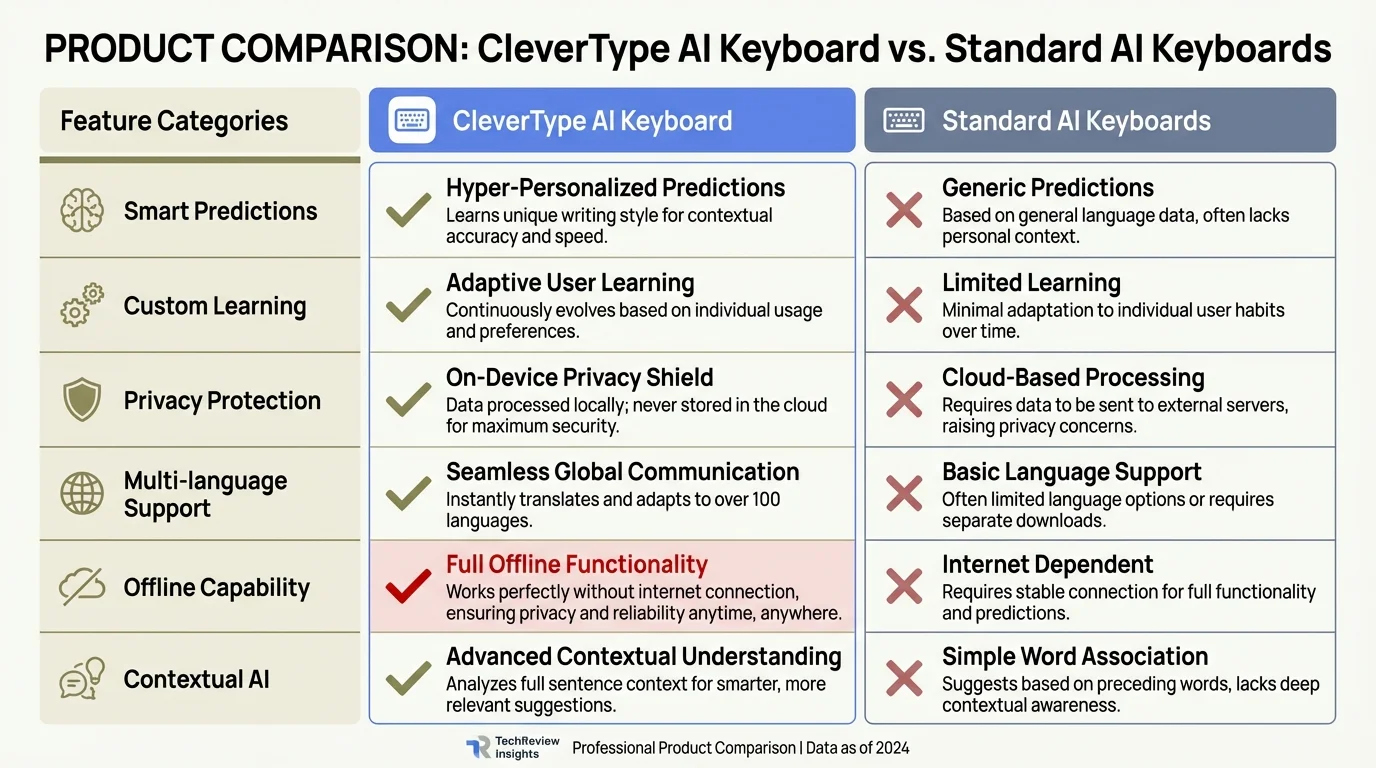
Comprehensive comparison showing how CleverType AI Keyboard stands out from standard AI keyboard options with advanced features and capabilities.
AI Keyboard Adoption in 2026: What's Changed
The AI keyboard landscape has transformed dramatically over the past year. What was once a niche productivity tool has become mainstream, with adoption rates that would have seemed impossible just 18 months ago.
Market research from early 2026 shows that over 23% of smartphone users worldwide now use some form of AI-enhanced keyboard—that's nearly 400 million people. Even more striking, among professionals under 35, adoption rates exceed 40%. This isn't just early adopters anymore; this is mainstream technology.
What drove this explosive growth? Three key factors stand out:
- Improved reliability: Early AI keyboards were buggy and unpredictable. Today's versions rarely crash and provide consistently helpful suggestions.
- Privacy advancements: Better on-device processing and clearer data policies have eased concerns that initially held many users back.
- Word of mouth: As more people experience the productivity benefits firsthand, they've become passionate advocates—nothing beats genuine recommendations.
Perhaps most interesting is how different demographics use these tools. Younger users tend to leverage AI keyboards for creative content and social media, while professionals focus on email efficiency and document drafting. Students use them as writing tutors, and non-native speakers find them invaluable for language confidence. The technology has proven remarkably adaptable to diverse needs.
How to Use a ChatGPT Keyboard Effectively
Having used ChatGPT keyboards extensively, I've learned a few tricks for getting the most out of them. Here are some practical tips:
Basic Commands and Prompts
Most ChatGPT keyboards work best with clear instructions. Try these starter prompts:
- "Rewrite this to sound more professional: [your text]"
- "Summarize this paragraph in 2 sentences"
- "Generate a response to this email that politely declines"
- "Fix grammar errors in this message"
The more specific your instruction, the better the result. For example, instead of asking "Make this better," try "Make this email more concise while maintaining a friendly tone."
Advanced Techniques
Once you're comfortable with the basics, try these advanced approaches:
- Chain prompts together: Ask the AI to improve your text, then ask it to make further refinements to its output.
- Specify your audience: "Rewrite this for a technical audience" or "Explain this concept to a 10-year-old."
- Use formatting commands: Many ChatGPT keyboards can format text in specific ways. Try "Create a bulleted list of the main points in this paragraph."
- Save common prompts: Most keyboards let you save prompts you use frequently, saving you even more time.
The learning curve isn't steep, but spending a few minutes exploring these techniques can significantly improve your results.
Privacy and Security Considerations
Let's address the elephant in the room: privacy. When you're using a keyboard that can see everything you type, privacy concerns are legitimate.
Understanding Data Handling
Different ChatGPT keyboards handle your data differently:
- Some process everything locally on your device
- Others send data to servers for processing
- Most reputable options anonymize data
- Premium services often offer enhanced privacy features
Before choosing a keyboard, check their privacy policy carefully. Look specifically for:
- Whether your text is stored permanently
- If your data is used to train AI models
- What personal information is collected
- Whether data is shared with third parties
Staying Safe While Using AI Keyboards
To protect your privacy while using ChatGPT keyboards:
- Use app-specific settings: Most keyboards allow you to disable AI features for specific apps like banking or password managers.
- Be cautious with sensitive information: Avoid typing passwords, credit card numbers, or highly personal information when using AI features.
- Check permissions: Make sure the keyboard only requests permissions it actually needs to function.
- Consider premium options: Paid versions often offer stronger privacy protections than free alternatives.
Remember, convenience always comes with some privacy tradeoffs. The key is making an informed decision about what you're comfortable with.
Comparing ChatGPT Keyboards with Traditional AI Tools
How do ChatGPT keyboards stack up against other AI writing tools like standalone ChatGPT, Grammarly, or Quillbot? As someone who's used them all, I can tell you there are significant differences.
ChatGPT Keyboards vs. Standalone Apps
| Feature | ChatGPT Keyboard | Standalone ChatGPT App |
|---|---|---|
| Accessibility | Available everywhere you type | Requires app switching |
| Context awareness | Sees what you're typing | Needs you to copy/paste context |
| Speed | Immediate in-line suggestions | Requires app launch and query time |
| Functionality range | More focused on writing assistance | Broader range of capabilities |
| Privacy concerns | Higher (sees all typing) | Lower (only sees what you share) |
Advantages over Traditional Grammar Tools
ChatGPT keyboards offer several benefits compared to traditional grammar checkers like Grammarly:
- More creative assistance: Beyond fixing errors, they can help generate content
- Contextual understanding: Better grasp of nuance and intended meaning
- Versatility: Help with a wider range of writing tasks
- Conversational interface: You can have a dialogue about your writing
However, dedicated grammar tools sometimes offer more precise technical corrections for specific grammar and style issues.
Limitations and Challenges
While ChatGPT keyboards are powerful, they're not perfect. Here are some limitations I've encountered:
Current Technical Constraints
While AI keyboards have improved tremendously, they still face some real-world challenges in 2026:
- Latency on slower connections: Response times can lag on 3G or congested Wi-Fi, though 5G networks have largely solved this for mobile users
- Context window limitations: Most keyboards can process around 4,000-8,000 words of context at once, which sounds like a lot until you're working on a lengthy document
- Battery consumption: Still higher than standard keyboards, though optimized models now use 15-20% less power than 2025 versions
- Learning curve for advanced features: While basic use is intuitive, mastering custom assistants and complex prompts takes time
- Occasional hallucinations: AI can still generate confident-sounding but incorrect information—you need to stay alert
Common Frustrations and Workarounds
Users frequently encounter these issues:
- Contextual misunderstandings: The AI sometimes misinterprets your intent. Workaround: Be more specific in your prompts.
- Keyboard switching lag: Switching between AI and regular keyboard can be clunky. Workaround: Use keyboard shortcuts to toggle features.
- Formatting inconsistencies: AI suggestions sometimes lose your original formatting. Workaround: Apply formatting after receiving suggestions.
- Over-reliance risk: It's easy to become dependent on AI assistance. Workaround: Practice writing without AI assistance regularly to maintain your skills.
Most of these limitations will likely improve as the technology evolves, but they're worth considering when deciding if a ChatGPT keyboard is right for you.
What's Next for AI Keyboards: 2026 and Beyond
We're living through the early days of AI keyboard evolution, and the pace of innovation is breathtaking. Based on what's already in beta testing and announced roadmaps, here's where this technology is heading:
Emerging Features Already in Testing
Several game-changing capabilities are rolling out in 2026:
- Multimodal understanding: Beta versions now let you reference screenshots or photos in your prompts—imagine typing "make this flyer text more professional" while showing your keyboard a design mockup.
- Emotion and tone detection: Advanced sentiment analysis helps the AI understand not just what you're saying, but how you're feeling, adjusting suggestions accordingly.
- Real-time collaboration features: Some keyboards are testing shared AI assistants for team conversations, maintaining context across multiple users.
- Biometric writing patterns: Your keyboard learns your unique writing rhythm, making suggestions that sound authentically like you.
- Predictive task automation: AI that doesn't just react to prompts but proactively suggests actions based on conversation patterns—like automatically drafting calendar invites from scheduling messages.
The Bigger Picture: How This Changes Communication
We're witnessing something profound: the transformation of writing from a solitary skill to a collaborative human-AI activity. This shift brings both opportunities and important questions:
- Linguistic democratization: People who struggle with writing—whether due to dyslexia, language barriers, or simply lack of confidence—can now communicate their ideas with clarity and impact. This isn't cheating; it's access.
- Evolving authenticity standards: We're developing new social norms around AI-assisted communication. Just as spell-check became unremarkable, AI suggestions are becoming an accepted part of the writing process.
- Professional skill shifts: The value is moving from raw writing ability to knowing what to ask for and how to refine AI output. Editorial judgment and strategic thinking matter more than perfect first drafts.
- Cross-cultural communication breakthroughs: Real-time, context-aware translation is making international collaboration smoother than ever imagined.
The philosophical questions are fascinating: If AI helps you articulate your thoughts better, are they still your thoughts? Most users are landing on "yes"—tools don't diminish ideas, they amplify them. Your keyboard isn't thinking for you; it's helping you think more clearly.
Is a ChatGPT Keyboard Right for You?
So after all this, should you actually use a ChatGPT keyboard? It depends on your specific needs and circumstances.
Who Benefits Most?
ChatGPT keyboards are particularly valuable for:
- Professionals who write frequently: People who draft emails, reports, or other documents throughout their workday
- Non-native English speakers: Those who want help communicating more fluently
- Students: Help with homework explanations and essay writing
- Social media creators: Anyone who creates content and needs creative assistance
- People with language-related disabilities: Those with dyslexia or other conditions that make writing challenging
Who Might Want to Skip It?
On the other hand, these keyboards might not be ideal for:
- Privacy-focused individuals: If you're concerned about data collection
- Those with very basic phones: The additional processing requirements can slow down older devices
- People who rarely write complex messages: If your texts are mostly "on my way" or emoji, the benefits may be limited
- Individuals working with highly sensitive information: Financial advisors, healthcare providers, etc.
Making Your Decision
When deciding, consider:
- Your daily communication needs: How often do you need writing assistance?
- Privacy comfort level: Are you comfortable with an AI seeing what you type?
- Device compatibility: Does your phone support these keyboards well?
- Budget: Are you willing to pay for premium features?
Most ChatGPT keyboards offer free versions, so you can always try one out before committing. You might be surprised at how quickly it becomes an essential tool in your digital life.
Frequently Asked Questions
Q: What is a ChatGPT keyboard and how does it work?
A: A ChatGPT keyboard is a mobile keyboard that integrates AI capabilities directly into your typing experience. It replaces your default keyboard and connects to OpenAI's API or similar language models, allowing you to access AI assistance in any app without switching contexts. You can get help with writing, grammar, translations, and content generation right from your keyboard interface.
Q: Are ChatGPT keyboards safe and private to use?
A: Reputable ChatGPT keyboards prioritize data security, but privacy varies by provider. Most process data on secure servers and don't permanently store conversations. However, you should review each keyboard's privacy policy, avoid typing sensitive information like passwords or credit card numbers when using AI features, and consider disabling AI functionality in banking or password manager apps.
Q: Do ChatGPT keyboards work on both iOS and Android?
A: Yes, most ChatGPT keyboards are available for both iOS and Android platforms. Popular options like CleverType support both operating systems, though some features may vary between platforms due to different system restrictions and capabilities. iOS has stricter keyboard API limitations compared to Android.
Q: How much do ChatGPT keyboards cost?
A: Many ChatGPT keyboards offer free tiers with basic functionality, while premium features typically require subscriptions ranging from $5-15 per month. Free versions often include limited AI queries per day or basic features, while paid versions unlock unlimited queries, advanced AI models, custom assistants, and enhanced privacy features.
Q: Can ChatGPT keyboards replace tools like Grammarly?
A: ChatGPT keyboards offer broader capabilities than traditional grammar tools, including content generation and conversational assistance, not just error correction. However, dedicated grammar tools sometimes provide more precise technical corrections. Many users find that ChatGPT keyboards complement rather than replace specialized writing tools, with some people using both for different purposes.
Q: Will using a ChatGPT keyboard drain my phone battery?
A: ChatGPT keyboards do consume more battery than standard keyboards due to AI processing and network communication, but the impact is generally moderate with modern devices. The actual drain depends on usage frequency, your device's age, and whether the keyboard processes data locally or on remote servers. Most users report acceptable battery performance, with newer 2026 models using 15-20% less power than previous versions.
Q: What languages do ChatGPT keyboards support?
A: Most ChatGPT keyboards support dozens of languages, including all major global languages like Spanish, French, German, Chinese, Japanese, Arabic, and many more. They can translate between languages, help you write in languages you're not fluent in, and correct grammar across multiple languages, making them invaluable for international communication and language learning.
Conclusion
In 2026, ChatGPT keyboards have crossed the threshold from experimental tech to essential tool for millions. This isn't hype—it's a fundamental shift in how we interact with technology. AI has moved from something we open in a separate app to something that flows naturally as we communicate.
The numbers tell part of the story: saved time, increased productivity, better communication across language barriers. But the real impact is more personal. It's the confidence you feel drafting an important email. It's the creative block you break through with a well-timed suggestion. It's the conversation you have in another language that would have been impossible before.
Yes, there are still considerations around privacy, authenticity, and maintaining our own writing skills. These concerns are valid and worth taking seriously. The key is approaching AI keyboards as tools that enhance rather than replace human capability—amplifiers for your thoughts, not substitutes for thinking.
As we look ahead, the trajectory is clear: AI keyboards will become more capable, more personalized, and more seamlessly integrated into our daily communication. The question isn't whether this technology will become ubiquitous—it's whether you'll benefit from adopting it now or wait until everyone else has already moved forward.
If you're curious, most options offer free trials. Take one for a test drive. You might be surprised how quickly it becomes indispensable. And if you're already using one, you probably already know what I mean.