AI Writing Assistant Features You Haven't Tried
Key Takeaways
- Voice-to-text transcription features can boost writing productivity by up to 3x compared to typing
- Custom AI assistants tailored to specific writing tasks produce more relevant outputs than generic prompts
- Advanced tone adjustment tools help maintain consistent brand voice across all communications
- Context-aware grammar correction adapts to different writing styles like academic or casual
- Multilingual support features can instantly translate and localize content for global audiences
- Keyboard shortcuts and templates significantly reduce repetitive writing tasks
- Privacy-focused writing modes protect sensitive information while still leveraging AI assistance
Have you ever felt like you're only scratching the surface of what your AI writing assistant can do? Most people are using just a fraction of the available features, missing out on tools that could revolutionize their writing process. What hidden gems are lurking in your AI writing software that you've never explored? And how might these overlooked capabilities transform your productivity?
I've spent years working with AI writing tools, and I'm constantly amazed at how many powerful features go unused. Research from Pew Research Center shows that most AI tool users only utilize basic text generation and grammar checking, leaving advanced capabilities untapped. Let's uncover those hidden treasures that'll make you wonder how you ever wrote without them.
In early 2026, the landscape of AI writing assistance has matured significantly. What were once experimental features have become reliable, everyday tools that genuinely change how we communicate. The question is: are you taking advantage of what's available?
Advanced Voice-to-Text Transcription Features
Did you know that most modern AI writing assistants have voice transcription capabilities that go way beyond basic dictation? This isn't your typical speech-to-text technology anymore.
Today's advanced voice features include:
- Punctuation prediction: The AI automatically adds commas, periods, and question marks based on your speech patterns and pauses
- Speaker identification: Some tools can distinguish between different speakers in a conversation
- Background noise filtering: Advanced algorithms that can isolate your voice from environmental sounds
- Accent recognition: Improved accuracy for non-native speakers with various accents
- Voice tone detection: Some systems can identify emotional cues in speech
- Real-time processing: Instant transcription as you speak, with AI-powered error correction that learns your speech patterns
GPT-4o Transcribe represents a significant leap forward in this technology. It can handle complex audio environments and maintain context throughout long recordings. The transcription quality is remarkably accurate even with multiple speakers or background noise. Modern speech recognition systems have achieved near-human accuracy, with transcription accuracy reaching 98% for clear audio, a substantial improvement from the 85-90% rates of just a few years ago.
A journalist friend of mine recently told me: "I used to spend hours transcribing interviews. Now I just record through my AI writing assistant, and it's done in minutes with better accuracy than I ever managed manually. Last month alone, I saved over 20 hours of transcription time."
For writers who struggle with typing or prefer to compose by speaking, this feature is life-changing. It's also perfect for capturing ideas on the go when you can't sit down to type. Many writers now compose entire first drafts using voice, then use AI editing tools to refine the text—a workflow that can cut drafting time in half.
Custom AI Assistants for Specific Writing Tasks
Generic AI writing is becoming outdated fast. Have you tried creating custom AI assistants tailored to specific writing tasks? This is where the real transformation happens.
Most users don't realize they can train their AI writing assistants to specialize in particular types of content. According to a 2025 study on AI writing tools, users who employ specialized custom assistants report 40% higher satisfaction with output quality compared to those using one-size-fits-all solutions. Instead of using the same generic AI for everything, you can create multiple specialized assistants:
| Assistant Type | Specialized For | Benefits |
|---|---|---|
| Email Assistant | Professional correspondence | Maintains appropriate tone, includes necessary details |
| Social Media Assistant | Platform-specific content | Understands character limits and hashtag optimization |
| Academic Assistant | Research papers and citations | Follows academic formatting and citation styles |
| Creative Writing Assistant | Stories and creative content | Focuses on narrative elements and character development |
| Technical Documentation Assistant | Technical guides and manuals | Uses precise terminology and step-by-step instructions |
Custom AI assistants can be trained with examples of your preferred writing style, common phrases you use, and even brand voice guidelines. This ensures consistency across all your content.
"I've set up five different writing assistants for different clients," says a freelance copywriter I know. "Each one understands the specific brand voice and style guide requirements. It's like having a specialized tool for each job rather than a one-size-fits-all approach. My turnaround time has improved by about 30% since implementing this system."
The beauty of custom assistants is that they get better over time as they learn from your feedback and corrections. They become increasingly aligned with your specific needs. By 2026, these systems have become remarkably sophisticated, with some able to recognize context shifts mid-document and adapt accordingly—like switching from informal brainstorming to formal presentation language automatically.
Context-Aware Grammar and Style Correction
Most people use basic grammar checking, but did you know that advanced AI writing assistants offer context-aware correction? It's not just about fixing typos anymore.
Context-aware grammar tools understand:
- The difference between formal and informal writing contexts
- Industry-specific terminology that might look like errors to basic checkers
- Regional language variations (UK vs. US English, for example)
- Technical terms that shouldn't be "corrected"
- When you're intentionally breaking grammar rules for stylistic effect
AI grammar keyboards now offer real-time suggestions that adapt to the type of document you're creating. They won't apply the same rigid rules to a casual text message that they would to a formal business proposal.
I remember when I was writing a medical article and my old grammar checker kept trying to "correct" specialized terminology. My new context-aware tool recognizes these terms and even suggests related medical terminology that might be more precise.
This feature is particularly valuable for non-native English speakers who need to navigate the nuances of the language in different contexts. The AI can help them sound natural in various situations rather than applying one-size-fits-all corrections.
Advanced Tone Adjustment Tools
Have you struggled with getting the right tone in your writing? Advanced tone adjustment goes beyond simple formal/informal toggles to offer nuanced control over how your message comes across.
Modern AI writing assistants can help you adjust your writing to sound:
- Authoritative without being condescending
- Friendly without being unprofessional
- Urgent without seeming panicked
- Empathetic without appearing insincere
- Technical without becoming incomprehensible
Tone adjustment features can transform a message while preserving its core meaning. This is invaluable for communicating effectively with different audiences.
A marketing director I know uses tone adjustment to maintain consistent brand voice across a team of content creators: "Before, our content had wildly different voices depending on who wrote it. Now, we run everything through our AI tone adjuster set to our brand voice parameters, and it creates a consistent experience for our readers."
Some advanced systems even offer emotion analysis, flagging content that might come across as angry or frustrated when that's not your intention. This can save you from sending an email you might regret later!
Multilingual Support and Cultural Adaptation
Did you know that advanced AI writing tools can do much more than simple translation? They can actually help you adapt your content for different cultural contexts.
Modern multilingual features include:
- Idiomatic translation: Preserving the meaning of idioms rather than translating them literally
- Cultural sensitivity checking: Flagging phrases that might be inappropriate in certain cultures
- Localization assistance: Adapting references, examples, and analogies to resonate with local audiences
- Formality adjustment: Automatically adjusting the level of formality based on cultural expectations
- Date and measurement format conversion: Switching between different international standards
Multilingual AI keyboards can help you craft messages that don't just translate your words but truly communicate your meaning across language barriers.
"I manage a global team, and our communication used to be full of misunderstandings," a project manager told me. "Now I write in English, and my AI assistant helps me adapt messages for team members in different countries, considering cultural nuances I wouldn't have known about."
For businesses expanding internationally, this feature ensures your content doesn't just speak the language but also respects local customs and communication styles.
Template and Snippet Management
Are you tired of writing the same types of messages over and over? Advanced template features go way beyond basic text substitution.
Smart template systems can:
- Learn from your writing patterns to suggest templates for recurring content
- Dynamically update templates based on context and recipient
- Merge multiple templates for complex documents
- Adapt to different platforms and formatting requirements
- Store and categorize snippets of text for easy reuse
- Auto-populate variables like names, dates, and project details
AI writing workflows combine these templates with other AI features to dramatically speed up content creation.
A customer support manager I spoke with said: "My team used to spend hours crafting responses to common questions. Now our AI assistant recognizes the type of inquiry and suggests the appropriate template, which the agent can then personalize. It's cut our response time in half while maintaining quality. We're now handling 60% more tickets with the same team size."
The most sophisticated systems can even analyze which templates perform best in terms of engagement or response rates, helping you continually refine your communication. In 2026, we're seeing AI that can A/B test different template variations automatically and recommend the highest-performing versions for different scenarios.
Privacy-Focused Writing Modes
Worried about sensitive information being processed by AI systems? Advanced writing assistants now offer specialized privacy modes that many users don't know about.
These privacy features include:
- Local processing options: Some operations happen on your device without sending data to the cloud
- Data redaction: Automatic identification and masking of sensitive information like names or account numbers
- Compliance modes: Special settings for handling regulated information (HIPAA, GDPR, etc.)
- Ephemeral processing: Data that isn't stored after processing is complete
- Zero-knowledge architecture: Systems designed so that even the provider can't access your content
Data security in AI keyboards has become increasingly sophisticated, allowing you to benefit from AI assistance without compromising confidentiality.
"As a lawyer, I was hesitant to use AI writing tools because of client confidentiality," an attorney told me. "The privacy-focused writing mode lets me get AI assistance while ensuring sensitive information stays protected. It automatically redacts client names and case-specific details."
For professionals in healthcare, legal, financial, or other sensitive fields, these privacy features make AI writing assistance accessible without ethical or compliance concerns.
Collaborative Writing and Feedback Tools
Writing doesn't happen in a vacuum, and advanced AI assistants now offer sophisticated collaboration features that go beyond basic commenting.
Modern collaborative AI writing tools can:
- Track changes and contributions from multiple authors
- Suggest consensus wording when collaborators disagree
- Highlight inconsistencies between different sections written by different people
- Provide objective feedback on clarity and effectiveness
- Facilitate asynchronous collaboration across time zones
These tools serve as both a writing assistant and a mediator between different contributors, helping teams create cohesive content even when working separately.
A content team lead shared: "Our blog posts used to feel disjointed when multiple writers contributed. Now our AI assistant helps maintain a consistent voice throughout and flags when one section contradicts another or uses a different tone. It's like having an editor who sees the whole picture."
For remote teams or organizations with contributors across different departments, these collaboration features ensure that the final product reads as if it came from a single, coherent source.
AI Writing Workflows and Feature Integration
Here's something most people miss: the real power of AI writing assistants comes not from individual features, but from combining them into seamless workflows. Think of it like cooking—individual ingredients are fine, but the magic happens when you combine them thoughtfully.
For example, a content creator might use this workflow: start with voice transcription to quickly capture ideas during a morning walk, have a custom assistant organize and expand those thoughts into an outline, apply tone adjustment to match brand voice, use context-aware grammar to polish the final draft, and then leverage multilingual features to create versions for international audiences. What would have taken days now happens in hours.
The key is thinking about your writing process holistically rather than as isolated tasks. Where do you lose time? Where do you struggle with consistency? Where does quality suffer? There's likely an AI feature combination that addresses each pain point. A 2025 productivity study found that users who create integrated AI workflows save an average of 12 hours per week compared to those using features in isolation.
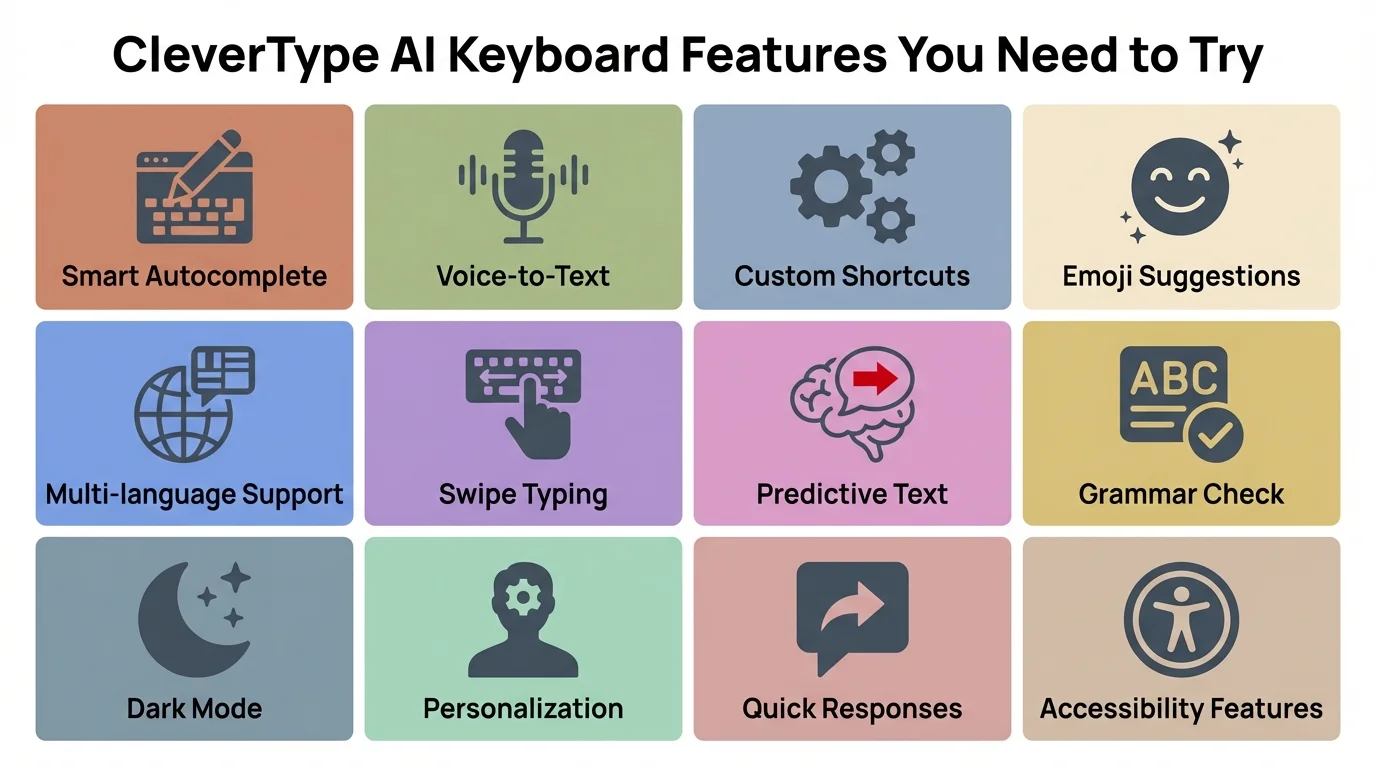
Key CleverType features that transform your writing workflow and boost productivity
The Future of AI Writing Features in 2026 and Beyond
Looking ahead, AI writing assistance is becoming even more contextually aware and proactive. We're moving toward systems that don't just respond to commands but anticipate your needs based on patterns in your writing behavior.
Emerging features on the horizon include predictive writing assistance that suggests entire paragraphs based on your document's direction, emotional intelligence that detects and helps manage cognitive load during complex writing tasks, and cross-document consistency checking that ensures your messaging remains coherent across an entire content library. Some early adopters are already testing AI systems that can manage entire content calendars, suggesting topics based on trends and audience engagement patterns.
The integration of AI writing tools with other productivity systems is also accelerating. Imagine your writing assistant that knows your calendar, understands your project management system, and can draft emails with full context of your commitments and deadlines. This level of integration is already becoming reality for forward-thinking teams in 2026.
Conclusion: Unlocking the Full Potential of AI Writing Assistants
We've only scratched the surface of what today's advanced AI writing tools can do. From voice transcription that understands context to custom assistants tailored to specific writing tasks, these features can transform your writing process.
The most powerful benefits come when you combine multiple features—using voice-to-text with a custom assistant, applying context-aware grammar correction with tone adjustment, or leveraging templates with collaborative tools. The difference between basic AI use and advanced feature utilization can mean the difference between marginal improvements and transformative productivity gains.
As AI writing technology continues to evolve, staying aware of new features can give you a significant advantage in productivity and content quality. Take some time to explore the less obvious capabilities of your writing assistant—you might be surprised at what's already available at your fingertips.
The question isn't whether AI can help you write better—it's whether you're taking full advantage of all the ways it can help. In 2026, the writers who thrive are those who view AI not as a novelty but as an integral part of their creative and professional toolkit.
CleverType offers many of these advanced features in a user-friendly package. If you're serious about improving your writing efficiency, it's worth exploring what this tool has to offer beyond the basics most users stick to.
Frequently Asked Questions
Q: What are the most underutilized AI writing assistant features?
A: The most overlooked features include advanced voice-to-text with punctuation prediction, custom AI assistants tailored to specific writing tasks, context-aware grammar correction that adapts to different writing styles, and privacy-focused writing modes that protect sensitive information while still providing AI assistance. Most users stick to basic text generation and spell checking, missing out on capabilities that could save them hours each week.
Q: How do custom AI assistants differ from generic AI writing tools?
A: Custom AI assistants are trained for specific writing tasks and can learn your preferred style, brand voice, and terminology. Unlike generic tools, they provide specialized suggestions for emails, social media, academic writing, or technical documentation, becoming more aligned with your needs over time. Studies show users report 40% higher satisfaction with output quality when using specialized assistants compared to one-size-fits-all solutions.
Q: Can AI writing assistants help with multilingual content?
A: Yes, modern AI writing assistants offer more than translation. They provide cultural adaptation, idiomatic translation that preserves meaning rather than literal word-for-word conversion, formality adjustment based on cultural expectations, and sensitivity checking to ensure your content resonates appropriately with different audiences worldwide. This goes far beyond what traditional translation tools offer.
Q: Are AI writing tools safe for handling sensitive information?
A: Advanced AI writing assistants now offer privacy-focused modes with features like local processing, automatic data redaction, compliance modes for regulations like HIPAA and GDPR, and zero-knowledge architecture. These features make AI assistance accessible for professionals in healthcare, legal, and financial fields without compromising confidentiality or regulatory compliance.
Q: How does context-aware grammar correction improve writing?
A: Context-aware grammar tools understand the difference between formal and informal writing, recognize industry-specific terminology that might look like errors to basic checkers, adapt to regional language variations, and know when you're intentionally breaking grammar rules for stylistic effect. This provides more intelligent suggestions than basic spell checkers, which often flag correct usage simply because it doesn't match rigid rules.
Q: What is tone adjustment in AI writing assistants?
A: Tone adjustment tools help you control how your message comes across by offering nuanced control beyond simple formal/informal settings. They can make writing sound authoritative without being condescending, friendly without being unprofessional, or empathetic without appearing insincere, while preserving the core meaning. This is particularly valuable for maintaining consistent brand voice across teams or adapting messages for different audiences.
Q: How much can voice-to-text features boost productivity?
A: Modern voice-to-text transcription can boost writing productivity by up to 3x compared to typing. Advanced features include automatic punctuation prediction, speaker identification, background noise filtering, accent recognition, and voice tone detection, making it far more powerful than basic dictation. In 2026, transcription accuracy has reached 98% for clear audio, and many writers now compose entire first drafts using voice, cutting drafting time in half.