AI Keyboards for Accessibility: Empowering Users with Motor Limitations
Key Takeaways
- AI keyboards offer predictive text, auto-completion, and voice typing that significantly reduce the physical effort needed for typing
- Customizable layouts and adjustable sensitivity settings help users with different motor abilities
- Switch access compatibility allows users to operate keyboards with minimal physical movement
- Voice-to-text features in 2026 achieve 99%+ accuracy rates, even with speech variations
- AI prediction can reduce keystrokes by up to 65-75% for many users, thanks to advanced contextual learning
- Modern AI keyboards integrate seamlessly with assistive technologies like screen readers, switch controls, and eye-tracking systems
- Accessibility-focused keyboards are available across iOS, Android, and emerging platforms like AR glasses
Ever tried typing with mittens on? That's kinda what life's like for folks with motor limitations when they use regular keyboards. But here's the good news - AI keyboards are changing the game completely! In 2026, these smart keyboards aren't just cool tech toys; they're genuine lifelines for millions who struggle with physical movement. According to recent WHO estimates, over 1.3 billion people worldwide experience significant motor challenges, and the digital divide has never been more apparent—or more solvable.
So what makes these keyboards so special for users with motor limitations? Let's dive in and explore how this technology is breaking down barriers and opening doors to digital communication for everyone. Whether you're living with cerebral palsy, arthritis, Parkinson's, or recovering from an injury, modern AI keyboards are transforming what's possible.
Understanding Motor Limitations and Digital Accessibility
What exactly do we mean by motor limitations? And why do they make typing so darn difficult?
Motor limitations refer to conditions that affect a person's ability to control their movements. These can range from mild tremors to severe mobility restrictions. Conditions like cerebral palsy, multiple sclerosis, ALS, Parkinson's disease, or injuries affecting the spinal cord or hands can all impact someone's ability to type on conventional keyboards.
For these users, traditional typing presents several challenges:
- Precision problems: Hitting small, specific keys accurately can be nearly impossible
- Fatigue issues: Even minimal typing can cause extreme exhaustion
- Speed limitations: Typing may be painfully slow, making communication frustrating
- Consistency struggles: Maintaining steady pressure or movement can be difficult
Before AI keyboards, the options were pretty limited. People relied on:
- Physical keyboard adaptations (like key guards or sticky keys)
- Basic word prediction that wasn't very smart
- Clunky switch systems that were slow and limited
- Early voice recognition that barely worked half the time
These solutions helped a bit but didn't really solve the fundamental problems. They were band-aids on a much bigger accessibility issue.
As Sheila Johnson, an occupational therapist specializing in assistive technology, explains: "The gap between what traditional keyboards could offer and what users with motor limitations actually needed was enormous. Basic adaptations helped, but they couldn't address the core inefficiencies in the typing process itself."
But then AI entered the picture, and everything started to change. By 2026, we're seeing the fourth generation of AI-powered accessibility features, with neural networks trained on millions of diverse typing patterns. The difference between what was possible in 2020 and what's available today is night and day.
The real breakthrough? These keyboards don't just predict words anymore—they understand intent, context, and individual movement patterns in ways that feel almost telepathic to users.
How AI Keyboards Transform the Typing Experience
So what's the big deal about AI keyboards? How do they actually help people with motor limitations?
AI keyboards use machine learning and predictive algorithms to drastically reduce the physical effort needed for typing. Instead of having to press every single key perfectly, these keyboards can:
- Predict what you're trying to type based on just a few keystrokes
- Correct for tremors or imprecise touches automatically
- Adapt to your unique typing patterns over time
- Offer multiple input methods beyond just tapping keys
Let's break down the specific features that make AI keyboards so revolutionary for accessibility:
Predictive Text and Word Completion
Imagine only needing to type a few letters before the keyboard suggests exactly what you wanted to say. That's the power of advanced predictive text. For someone with limited dexterity or strength, this means:
- Fewer required keystrokes (up to 65-75% less typing in 2026!)
- Dramatically reduced physical fatigue from extended typing sessions
- Faster communication speeds that rival or exceed able-bodied typing
Unlike older word prediction, modern AI prediction learns from your personal writing style, vocabulary choices, and common phrases. It gets smarter the more you use it, becoming almost like a typing partner who knows what you're thinking. In 2026, multimodal AI models can even factor in your recent conversations, calendar events, and current location to make eerily accurate predictions about what you want to say next.
Customizable Layouts and Sensitivity
One size definitely doesn't fit all when it comes to accessibility. AI keyboards excel by offering:
- Adjustable key sizes for different precision abilities
- Customizable keyboard layouts to match specific movement patterns
- Sensitivity settings that can be tuned to prevent accidental touches
- Visual and haptic feedback options that can be personalized
Marcus Lee, who has cerebral palsy, shared his experience: "I used to avoid typing messages completely because it was so frustrating. With my customized AI keyboard setup, I can adjust everything to match exactly what works for my specific movements. It's like the keyboard was built just for my hands."
Voice-to-Text Integration
For users with severe motor limitations, voice input represents freedom from physical typing altogether. Modern AI voice recognition in 2026 offers:
- Accuracy rates exceeding 99% even with speech impediments, accents, or atypical speech patterns
- Natural language processing that understands context, sarcasm, and nuanced meaning
- Punctuation and formatting commands through voice, including emoji insertion and text styling
- Real-time multilingual support for over 120 languages with seamless code-switching
- Background noise cancellation that works even in busy environments
The combination of these features creates a typing experience that adapts to the user rather than forcing the user to adapt to the technology. And that's a huge shift in accessibility thinking. As one user put it, "My keyboard finally speaks my language—literally and figuratively."
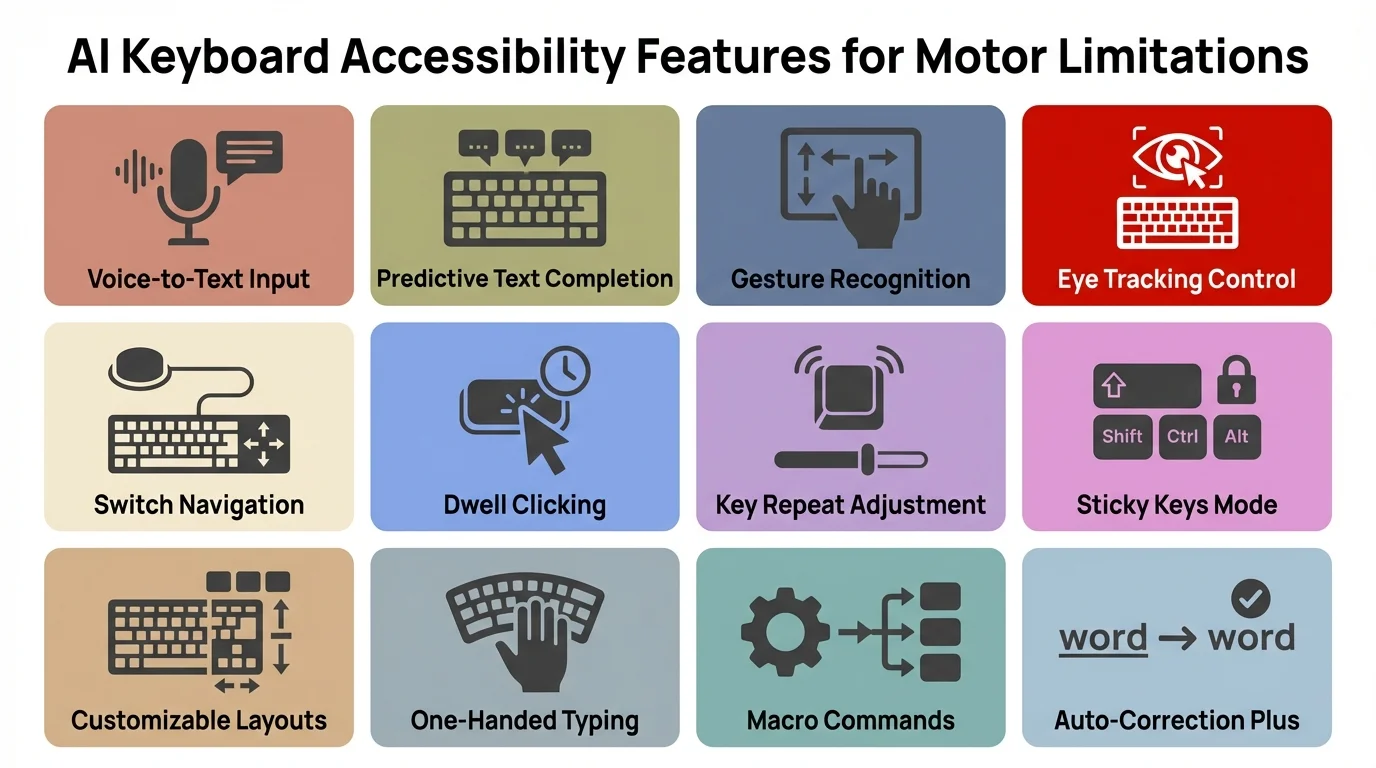
Key accessibility features that make AI keyboards essential tools for users with motor limitations
Leading AI Keyboard Solutions for Users with Motor Limitations
What options are actually available for users with motor limitations? Let's look at some of the most effective AI keyboard solutions currently on the market:
CleverType
CleverType has emerged as a leader in accessible AI keyboards with features specifically designed for users with motor limitations:
- Ultra-high prediction accuracy that learns from minimal input
- Customizable sensitivity settings for various motor control levels
- Integration with external assistive devices
- Continuous learning that adapts to changing abilities
As one user with multiple sclerosis noted: "CleverType seems to know what I'm going to say before I do. On days when my hands are particularly shaky, it's like it compensates automatically."
Google's Gboard with Accessibility Features
Google has invested heavily in making Gboard more accessible:
- Voice typing with offline capabilities
- Morse code input option for users with severe motor limitations
- Glide typing that requires minimal precision
- Switch Access compatibility for alternative input methods
Apple's AssistiveTouch and Predictive Keyboard
iOS devices offer integrated solutions that work well with motor limitations:
- AssistiveTouch for customized touch interfaces
- Advanced word prediction that learns from user habits
- Voice Control for comprehensive hands-free operation
- Switch Control for alternative input methods
Specialized Solutions likeTecla
Some third-party solutions focus exclusively on motor accessibility:
- External switch interfaces that connect to AI keyboards
- Breath-controlled input options
- Eye-tracking compatibility with AI-powered gaze prediction
- Customized physical interfaces that work with AI prediction
The Rise of Hybrid Input Systems in 2026
One of the most exciting developments in 2026 is the emergence of hybrid input systems that combine multiple accessibility methods into one seamless experience. These systems let users switch effortlessly between voice, touch, switch access, and even gaze-based input depending on their current needs and environment.
For example, someone might use voice input while working alone at home, switch to predictive touch typing in a quiet office, and rely on switch access during periods when tremors are more pronounced. The AI learns when to prioritize which input method, creating a truly adaptive experience that respects the fluctuating nature of many motor conditions.
The key is finding which solution matches a user's specific needs and abilities. As Dr. Maya Patel, accessibility researcher, points out: "The best AI keyboard for motor limitations is the one that becomes invisible to the user—where they can focus on what they want to say rather than how they're going to type it." In 2026, we're closer to that ideal than ever before.
Real-World Impact: Stories of Empowerment
The true measure of AI keyboard effectiveness isn't in the features list—it's in how they change people's lives. Here are some real examples of how this technology is making a difference:
Professional Independence
Jamie Cohen, a software developer with spinal muscular atrophy, shares: "Before AI keyboards, I couldn't code efficiently enough to keep up with my team. Now, with predictive coding suggestions and my customized keyboard layout, I'm often the fastest programmer in our sprints. The technology literally saved my career."
Educational Access
Fifteen-year-old Sophia Martinez, who has cerebral palsy, used to require a full-time aide to take notes in class. "With my AI keyboard setup, I can take my own notes now. The prediction is so good that I can keep up with the teacher, and it feels amazing to be independent."
Social Connection
For many users, the impact on personal relationships is most meaningful. Robert Taylor, who developed Parkinson's disease, explains: "I stopped texting my grandkids because it was too frustrating and slow. Now I can keep up with our family group chat, and they say they can't even tell I'm using any special technology. I'm just Grandpa again, not Grandpa-who-can't-type."
Mental Health Benefits
The psychological impact shouldn't be underestimated. "There's a special kind of frustration that comes from knowing exactly what you want to say but not being able to get your body to cooperate," explains occupational therapist Lisa Wong. "When AI keyboards remove that barrier, we often see improvements in mood, confidence, and willingness to engage socially."
These stories highlight an important truth: accessible technology isn't just about completing tasks—it's about enabling full participation in digital life.
Challenges and Limitations of Current Solutions
Despite the impressive advances, AI keyboards aren't perfect yet. Users still face several challenges:
Learning Curves and Cognitive Load
Some AI keyboards require significant setup and learning time, which can be challenging for users who also have cognitive limitations. The more customizable a keyboard is, the more overwhelming it can initially seem.
"I spent almost two weeks configuring my keyboard perfectly," admits Marcus Lee. "It was worth it, but that's a big investment of time and energy that not everyone can manage."
Accuracy Variations Across Conditions
Different motor conditions present unique challenges that AI doesn't always handle equally well:
- Tremors might be easier for AI to compensate for than unpredictable spastic movements
- Progressive conditions require keyboards that can adapt as abilities change
- Combined motor and speech impairments can limit the effectiveness of voice alternatives
Cost and Accessibility Barriers
Many of the most advanced solutions come with significant price tags:
- Premium AI keyboards often require subscription fees
- Specialized hardware interfaces can cost hundreds or thousands of dollars
- Limited insurance coverage for "non-medical" assistive technology
Privacy Concerns
The very learning that makes AI keyboards effective also raises privacy questions:
- Personal typing data may be stored or processed on remote servers
- Medical information might be inadvertently revealed through typing patterns
- Dependency on connectivity can expose sensitive information
These challenges don't negate the benefits of AI keyboards, but they do highlight areas where continued improvement is needed.
Future Developments: What's on the Horizon
The field of accessible AI keyboards is evolving rapidly. What can users expect in the coming years?
Brain-Computer Interfaces
Perhaps the most exciting frontier is the development of direct brain-to-text interfaces. In 2026, these are no longer purely experimental:
- Neural implants that detect intended language directly from brain activity, with several FDA-approved devices now available
- Non-invasive EEG headsets that can interpret thought patterns with increasing accuracy
- Hybrid systems that combine minimal physical input with neural signals for enhanced reliability
- Consumer-grade BCI keyboards expected to launch in late 2026 and early 2027
What was experimental just two years ago is now moving into early adoption. Real users with ALS and locked-in syndrome are already typing at speeds exceeding 40 words per minute using nothing but their thoughts. This isn't science fiction—it's happening right now.
Advanced Contextual Understanding
Next-generation AI keyboards will better understand not just words but intentions:
- Prediction based on conversation context and relationship with the recipient
- Adaptation to different writing contexts (professional emails vs. casual chats)
- Integration with calendar, location, and other contextual data
Multimodal Input Integration
Future keyboards will likely combine multiple input methods seamlessly:
- Simultaneous voice and touch input for maximum efficiency
- Gesture recognition alongside traditional typing
- Eye tracking combined with minimal touch confirmation
Personalized Motor Pattern Recognition
AI will become even better at recognizing individual motor patterns:
- Distinction between intentional and unintentional movements
- Adaptation to daily fluctuations in motor control
- Predictive compensation for progressive conditions
AI Agents and Autonomous Assistance
Looking beyond 2026, AI keyboard assistants are becoming increasingly autonomous. Instead of just predicting what you'll type next, they're beginning to handle entire communication tasks:
- Draft entire emails or messages based on brief voice instructions
- Automatically adapt tone and formality based on the recipient and context
- Suggest personalized responses to incoming messages
- Handle routine communications autonomously with user approval
For users with motor limitations, this means less physical effort and cognitive load. The keyboard becomes less of a tool and more of a collaborative partner in communication.
Dr. Eliza Montgomery, neurologist and assistive technology researcher, notes: "We've already seen AI keyboards reduce the physical effort of typing by 70-80% for most users with motor limitations. With the combination of multiple input methods, autonomous assistance, and truly personalized prediction, we're approaching a future where motor limitations don't have to limit digital communication at all."
Practical Tips for Choosing and Setting Up an AI Keyboard
If you or someone you know could benefit from an accessible AI keyboard, here are some practical tips for getting started:
Assessing Individual Needs
Start by understanding the specific motor challenges involved:
- What movements are easiest and most reliable?
- Does fatigue play a significant role?
- Are there cognitive considerations alongside motor limitations?
- What are the primary typing tasks (social, professional, creative)?
Testing Multiple Solutions
Don't settle for the first option you try:
- Most AI keyboards offer free trials or basic versions
- Experiment with different layouts and settings
- Test at different times of day when motor abilities might vary
- Consider combining approaches (e.g., voice for longer text, touch for quick replies)
Customization Is Key
Take time to personalize whatever solution you choose:
- Adjust sensitivity settings to match your specific touch pattern
- Customize word predictions with your vocabulary
- Set up shortcuts for frequently used phrases
- Regularly update your preferences as needs change
Seek Expert Input
Don't hesitate to consult with specialists:
- Occupational therapists can provide personalized recommendations
- Assistive technology specialists can help with setup and training
- User groups often share valuable real-world tips and workarounds
Remember that finding the right solution often takes time and experimentation. "The perfect AI keyboard setup is like a well-fitted prosthetic," explains assistive technology consultant James Wilson. "It needs to be precisely matched to the individual and may require ongoing adjustments as needs or abilities change."
The Broader Impact: Beyond Individual Empowerment
The development of accessible AI keyboards represents more than just technological innovation—it reflects and contributes to broader social changes:
Workplace Inclusion
As digital communication becomes central to most careers, accessible typing technology directly enables workforce participation:
- Remote work opportunities become viable for more people with motor limitations
- Communication-heavy roles open up to talented individuals previously excluded
- Workplace accommodations become simpler and less expensive to implement
Educational Equity
Students with motor limitations can participate more fully in educational settings:
- Note-taking independence reduces reliance on accommodations
- Equal participation in digital classroom activities
- Reduced cognitive load allows focus on content rather than the mechanics of typing
Social Integration
The social impact extends beyond professional and educational settings:
- Participation in fast-paced digital conversations becomes possible
- Self-expression through writing, blogging, and social media opens up
- The "digital divide" for people with disabilities narrows
Changing Perceptions
Perhaps most importantly, these technologies are helping change how society views disability:
- Focus shifts from limitations to capabilities
- Technology adapts to humans rather than humans adapting to technology
- Accessibility becomes recognized as an innovation driver, not just a compliance issue
As disability rights advocate Jenna Brooks puts it: "When I can communicate at the same speed as everyone else, people stop seeing my disability first and start seeing me. AI keyboards aren't just tools—they're equalizers."
Frequently Asked Questions
### Q: Do AI keyboards work with existing assistive technology devices?
A: Yes, most modern AI keyboards integrate seamlessly with existing assistive technologies including switch controls, screen readers, eye-tracking systems, and external input devices. Many platforms like iOS and Android have built-in accessibility APIs that ensure compatibility across different tools, so you can combine your preferred AI keyboard with other assistive technologies you already use.
### Q: How much do accessible AI keyboards cost?
A: The cost varies widely. Basic AI keyboard features are often built into free platform keyboards like Gboard and Apple's native keyboard. Premium options with advanced features typically range from $5-30/month for subscriptions, while specialized hardware interfaces can cost $200-2,000. Some insurance plans and assistive technology programs may cover these costs, so it's worth checking with your provider.
### Q: Can AI keyboards adapt if my motor abilities change over time?
A: Absolutely. One of the biggest advantages of AI keyboards is their ability to continuously learn and adapt. As your abilities fluctuate—whether day-to-day or over longer periods—the AI adjusts its predictions, sensitivity settings, and input methods accordingly. Many users with progressive conditions like MS or Parkinson's report that their keyboards actually get better at compensating as their condition changes.
### Q: Is my typing data private and secure with AI keyboards?
A: Privacy varies by provider, so it's essential to review each keyboard's privacy policy. Some AI keyboards process all data locally on your device, while others use cloud processing for more powerful predictions. Look for keyboards that offer on-device learning, encrypt your data, and clearly state they don't sell your information. Many accessibility-focused keyboards prioritize privacy as a core feature given the sensitive nature of communications.
### Q: What's the learning curve for setting up an AI keyboard?
A: It depends on the complexity you need. Basic AI keyboard features work immediately with minimal setup, often just requiring you to enable them in settings. More advanced customization—like adjusting sensitivity, creating custom layouts, or integrating with specialized hardware—can take days or weeks to perfect. Many users find working with an occupational therapist or assistive technology specialist helpful for initial setup. The good news is that once configured, these keyboards require very little ongoing maintenance.
### Q: Can voice-to-text work for people with speech impairments?
A: Yes, though effectiveness varies. Modern AI voice recognition in 2026 has made significant strides in understanding atypical speech patterns, accents, and speech impairments. Some keyboards allow you to train the voice recognition specifically on your speech, dramatically improving accuracy. For users with severe speech impairments, hybrid approaches combining minimal voice input with other methods like predictive touch or switch access often work best.
### Q: Are AI keyboards available in languages other than English?
A: Definitely. Most major AI keyboards support dozens to over 100 languages, with features like predictive text, voice input, and auto-correction available across many languages. Some keyboards even support real-time language switching and multilingual predictions for users who communicate in multiple languages. The quality of AI features is most advanced in widely-spoken languages, but support for less common languages is expanding rapidly.
Conclusion: A More Accessible Digital Future
AI keyboards represent a significant leap forward in digital accessibility for users with motor limitations. By reducing physical barriers to typing, these technologies are opening doors to education, employment, social connection, and self-expression.
While challenges remain—from cost barriers to privacy concerns—the trajectory is clear: typing technology is becoming increasingly adaptable to human needs rather than demanding that humans adapt to technology.
For users with motor limitations, this shift means more than convenience; it means independence, inclusion, and equal participation in digital life. As AI continues to advance, we can expect even more sophisticated solutions that further reduce barriers and expand possibilities.
The ultimate goal isn't just better keyboards—it's a world where technology adapts so seamlessly to diverse human abilities that the concept of "disability" itself is transformed. AI keyboards are an important step toward that more accessible future.